


Getting the Good out of the Gutters
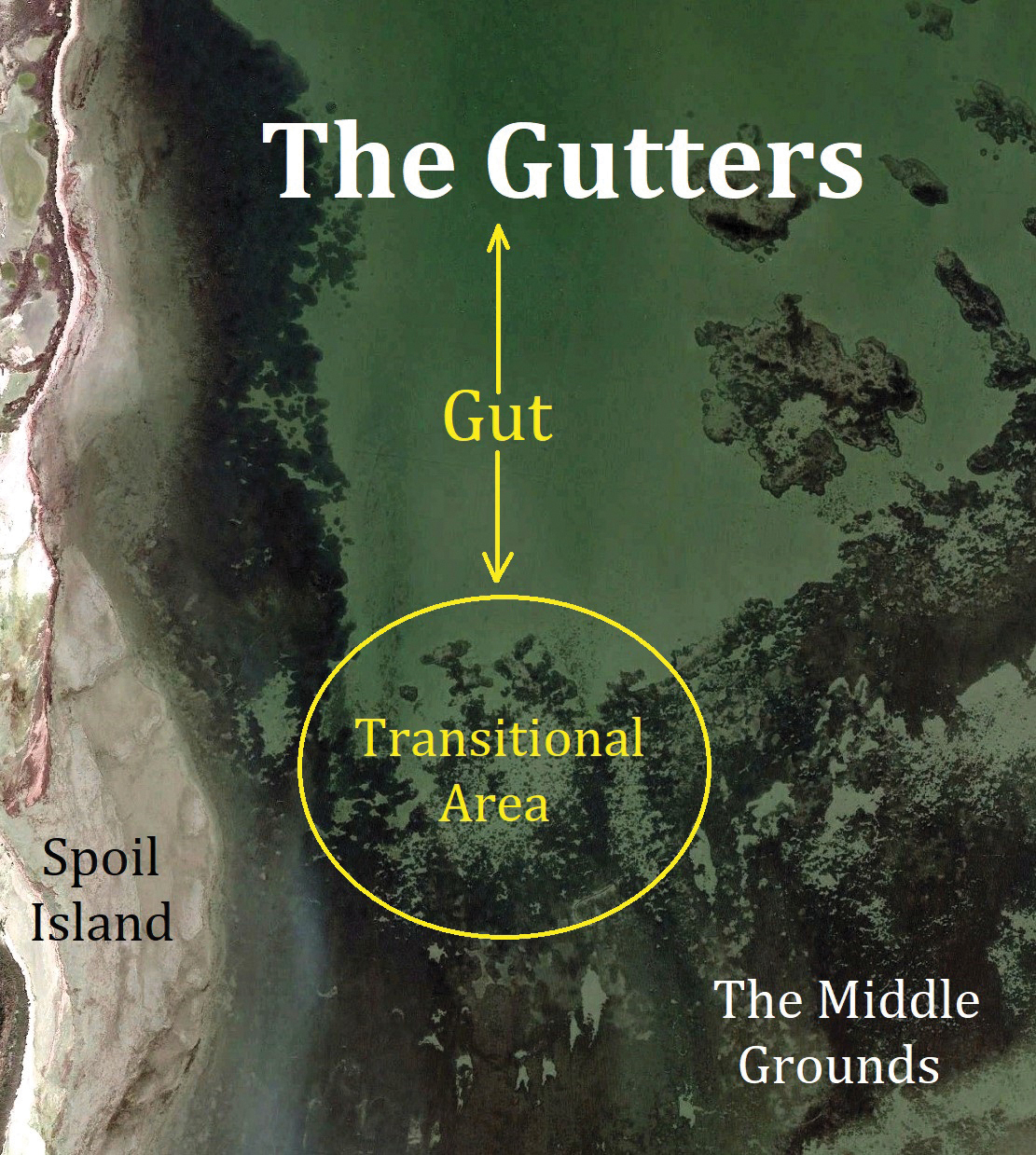
Excluding the narrow channel known as the Intracoastal Waterway, the Yarbrough Basin holds the deepest water in the Upper Laguna Madre, averaging about seven feet. Lying between Baffin Bay and the Land Cut, this area holds prime potential for producing trout of epic proportions. Framed on its east side by Padre Island, flanked on its west by a series of small spoil islands adjacent to the Intracoastal and bordered on both its southern and northern ends by vast, shallow flats, Yarbrough has several famous spots, frequented by many of the area's top trout hunters and guides.
In its southern end, an old oil-field channel runs out of the depths and into a huge expanse of shallow water known as the Middle Grounds. This channel basically bisects Murdock Flats, an area with a name generated many decades ago, before the Land Cut connected the two Laguna Madres. A generally east to west oriented edge formed by grass-capped sand bars separates the Yarbrough Basin from Murdock Flats.
For the most part, fishing Murdock's means working either the edge of the sand bars which sit at the cusp of the flat, where the water slopes into the basin, or working the shallows farther away from the edge, toward the Middle Grounds. People can and do catch some true trophy trout in Murdock's, most of which come to the hands of waders who sight-cast them in water barely deep enough to cover their boots. Most anglers don't relish the idea of covering lots of acreage on foot, fishing for trout in super skinny water while hoping for a few opportunities to cast directly at big fish, after spotting them.
For the average angler, in most situations, the area with the ripest potential for producing trophy trout in South Yarbrough is a place known by most locals as the Gutters. This area lies in the southwest corner of Yarbrough, tucked between Murdock's and the long spoil island lying on the east side of the northern entrance to the Land Cut. This spoil protects the famous area to its west, known as Summer House, from the wrecking effects of strong onshore winds, but it does nothing to help the water in the Gutters hold up when such winds whistle intensely.
So, anglers hoping to catch fish in the Gutters generally benefit from benign conditions. Generic summer weather provides those on a daily basis. In this windy region, during the dog days, wind speeds do normally ramp up somewhat in the afternoon hours, but light onshore winds or westerly winds whisper most mornings, allowing the water in the Gutters to hold its clarity well. Hot weather also creates patterns which tilt the odds in favor of anglers hunting monster trout in this place.
Apparently, the name Gutters came about naturally, as a result of people taking the general layout of the area into account. A long, natural gut lying adjacent to the spoil island defines the place, widest on its northern end, narrowest in its southern extremes, where it fizzles out and enters a transitional area with depths intermediate between the shallows of the Middle Grounds and the gut. Wading in the gut proves basically impossible, though it reaches depths of only four feet or so. Anyone who has tried will attest to the fact the super soft bottom will swallow one up to the knees or worse, making movement difficult, even dangerous.
Though waders can't venture into the gut, they can work the grassy flats on both sides of it. Significantly, fish do use the gut as a kind of highway, a path to pass from the depths of the basin into the shallows of the Middle Grounds, especially when water temperatures reach extreme values, either hot or cold. I know this to be true because I've seen it with my own two eyes. One poignant memory stands out among many which prove big trout swim up the gut to access the potholes in the transitional area at its southern end.
On the calm summer morning, quiet settled over a slick surface on the water of the ULM. I stood in knee-deep water to the southeast of where the gut funnels into the transitional area between the Gutters and the Middle Grounds. A huge school of mixed red and black drum surrounded me; they finned around slowly, actually bumping into my legs at times. I'd caught a few reds and regular-sized trout on a Super Spook early, before the bite slowed to a crawl. While debating whether to try some other kind of lure, I saw something which focused my attention intently.
I watched some kind of large fish rise out of the depths of the gut and move into the shallow water covering grass beds framing silty potholes in the transitional area, pushing a tall wake ahead as it went. Just beyond my casting range, the fish began moving westward, toward the spoil island, away from me. I began chasing after the moving wall of water, struggling to cover distance in the soft potholes. I quickly realized I'd never catch up to the fish, which I feared would head off into the Middle Grounds and disappear. Then, a stroke of luck blessed me.
The fish turned and swam eastward, toward where I stood, not in a direct line, but coming ever closer as it weaved through the potholes, eventually nearing my casting range. I freed the spool on my reel when it came right to the edge of my reach, then waited a little longer before sending my Spook out beyond where I could see evidence of the fish, then pulling it directly into its path. As the wake came within a few feet of my bobbing plug, the fish stopped, and I twitched my rodtip four or five times, walking the dog right into the strike zone.
And then it happened. A trout of epic proportions shattered the silence, blasting off on the cigar shaped plug and knocking it at least three feet into the stagnant air while emerging completely free of the water. To this day, I wonder how big the fish was; she appeared supernaturally huge. We'll never know, because none of the nine points on the treble hooks riding on my plug stuck in her skin. After she landed with a loud splat, she swam swiftly to the north and west, still pushing a steep wake, then slid back down into the world from which she had risen.
I, along with my customers and friends, have caught quite a few big trout in and near the Gutters during the summer heat wave, usually while we're cussing the reds, culling through numbers of them. I vividly remember sizzling days on which we caught dozens of keeper reds and a handful of trout measuring between 26 and 30 inches. Normally, though, the Gutters produces big trout better during the milder seasons of spring and fall, when water temperatures range from the 60s into the low-80s.
During transitional months like April and October, this area can fill up with the kind of trout trophy hunters covet. But tide levels in those months, associated with the two equinoxes, often run high. While bull tides make accessing the shallows at the southern end of the Gutters' namesake gut in a boat easier, they also urge the trout to move into the vast expanse of shallows in the Middle Grounds, where they can prove difficult indeed to locate. In an ideal situation during spring and fall, low tides pull water out of the Middle Grounds, leaving the shallowest parts of the area high and dry and driving the fish toward the Gutters, concentrating them in the transitional area.
In situations like those, anglers throwing slow-sinking twitchbaits, conventional topwaters and other floating lures which dive to shallow depths when twitched, then float back toward the surface on the pause, sometimes catch numbers of big trout, including some meeting or exceeding the 9-pound and 31-inch marks. Often, floating versions of Paul Brown Lures produce well in such situations. At other times, soft plastics rigged a foot or so under small corks provoke strikes from the monsters better than all other offerings.
The silty potholes forming the transitional area produce best, but the edges of the grass beds framing the gut also produce big fish. Sometimes, especially when moderately strong winds blow at the bank of the spoil island, wading the shallows between the gut and its shoreline prove most productive. Less often, big trout lurk in the depths of the gut, aggressively biting lures worked over its mooshy bottom. This pattern works better in the year's coldest season.
During the winter months, big trout sometimes retreat from the shallows of the Middle Grounds while temperatures rapidly descend after the passage of a strong cold front. When temperatures bottom out and begin to tick upward, the same fish use the gut to make their way back toward the shallows, sometimes stopping and staging on the soft muck for a while before venturing back out into the grass beds and potholes. Some of the best action in this area occurs during warm spells after north winds calm in the wake of a strong front.
My friend Jason King alerted me to the possibility of something significant happening down there one January, when he and a friend caught a bunch of over-sized and upper-slot reds on a day when water temperatures barely nudged up to about 50F after bottoming out in the mid-40s. The next day, when I arrived and punched the Power Pole into the mud just east of the transitional area, I could see multiple wakes to the south of us. Before we could get out of the boat, I saw at least a half dozen shrimp jump out of the water, fleeing the snapping jaws of hungry predators.
"Boys, I see what I see," I told my customers. "We ain't worth much if we don't catch 'em in here today." We did proceed to catch plenty of trout and reds that day, including one trout weighing well over nine pounds. For the next few days, while the water gradually warmed and the tide level rose, we caught a bunch more. These kinds of scenarios have graced me and many others amply over the years, in this place with the ugly name and the pretty potential.