


Hunting the Midnight Tiger
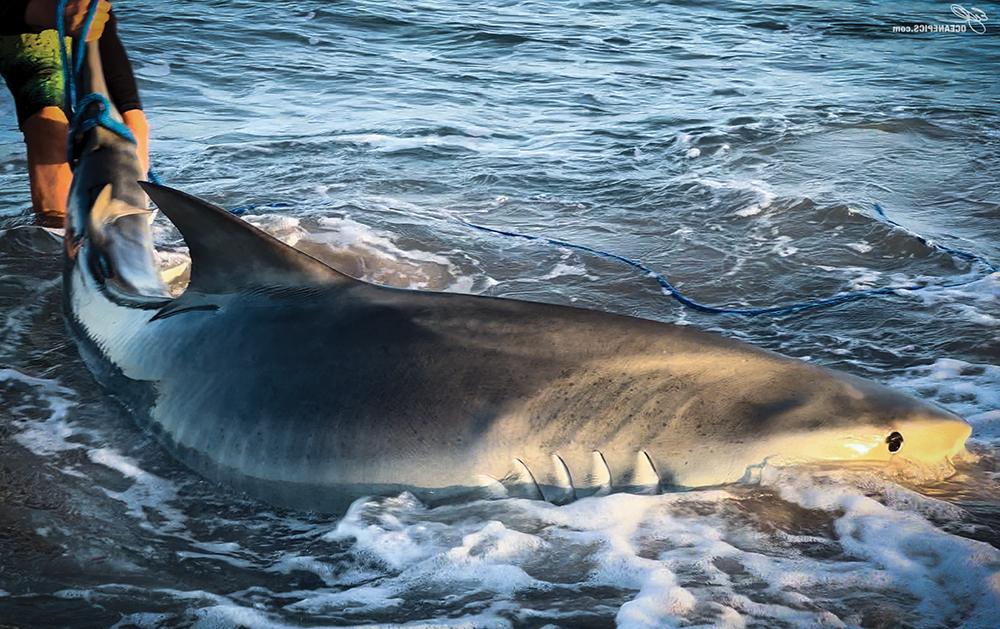
Giant early morning tiger, ready for release.
Hunting big sharks has been my core interest for most of my adult life. Most who know me think of me as The Shark Guy. I've pursued the Gulf's largest predators for a quarter of a century now and have been lucky enough to land and release over 15 different species of toothy critters in Texas waters. I caught the vast majority of them out of the surf, but I've also tangled offshore with silky sharks, dogfish, cat sharks and even the elusive oceanic whitetip shark.
These days, more than ever before, I yearn to find my way into a fight with a shark I've never landed before. Each species displays unique characteristics, and to gaze into their eyes offers us a glimpse into nature's epicenter. I find many species of sharks intriguing, but of all the sharks I've encountered, one holds a claim as my spirit animal―the majestic tiger shark.
Galeocerdo cuvier occupies a special place in my heart for good reason. During the introductory period to my life's work of shark fishing, as one century rolled into another, I spent lots of time fantasizing about the monsters of the ocean, ones I hoped to find on my angling expeditions. During those days, we had no drones and remote-controlled boats to use for bait deployment. All strikes and sharks were hard-earned, after we plowed through the waves on kayaks, jet skis or inflatable Zodiacs to dunk our baits in the brine.
Partly because of this handicap, we caught fewer monster sharks back then. Because of improvements in technologies and gear and the dissemination of useful information via social media and the internet, we have caught many more sharks today than ever before. People think we have more sharks these due to a population explosion, but I contend our perception of shark numbers is skewed by our improved ability to catch them. Surely, the warm summer months offer us the best potential for encountering some truly epic specimens.
As we get into the warmest part of the year, during the sweltering doldrums, I routinely deploy the largest baits I can find, mostly hoping to entice a tiger into a fight. The chance of catching tigers during July and August reaches a peak for good reasons. Large stingrays invade our beachfront waters, mostly at night. Both southern and roughtail rays come into the shallows to feed, often between the beach and the first bar.
The largest rays reach weights more than 200 pounds; some of them are also pregnant and vulnerable. For a 1000-pound tiger shark or 14-foot hammerhead, these flat, dangerous rays provide an ultimate buffet. Some of the biggest sharks in the Gulf prowl close to the beach on these sultry summer nights, hoping to chase down and eat the rays. Prey like jack crevalle, drum and tarpon also stay on the menu for both tigers and hammers, but the relatively slow tigers in particular prefer the rays over the more elusive species.
When I target tigers, whether on charters or for myself, the process always starts the same way; I deploy giant baits. Southern and roughtail rays are fairly easy to catch for use during the summer months, so they account for at least half of the baits I use during the heat wave. When they're available, I obtain cownose stingrays, a slightly smaller species of ray with oily, bloody, somewhat soft flesh. The only issue with cownose rays is their softness. Sharks commonly rip them right off the hook.
Ideally, I like to deploy multiple types of big baits. If I can, I send out two or three different types of rays, along with whole or giant chunks of jack crevalle. Varying the sizes of the baits enhances one's chances too, as some really big sharks seem to prefer whole rays and fish, while others more readily attack smaller offerings.
During typical tiger missions, I like to get two to four big baits distributed in an even spread, ranging from 400 to 800 yards from the sand. I prioritize having the fresh baits out about a couple hours before sunset. From all my experience, the majority of big tigers feed from the late-afternoon hours through the last hour of night. Having the baits deployed before darkness falls increases the chances for a hook-up once the beasts come into the surf to feed.
I'm often asked how moon phases affect my strategies. Truth be told, I've caught an array of tigers and other sharks during every possible tide and lunar cycle. That said, I've also learned how the summer full moons produce enhanced windows for big shark activity. The pitch-black nights associated with new moons also generate elevated amounts of activity among these apex predators. The effects of these strong moon phases are measurable, but folks heading to the beach should focus more on getting the right kinds of big, fresh baits out in a properly aligned spread than on how big or small the moon is and when it will fall and rise.
People specifically targeting tigers need to realize some of these creatures are huge indeed. Being prepared to handle a shark weighing several hundred pounds or more means having other people around to help with the landing and release processes. Unlike some of the feistier sharks, like bulls, tigers are relatively docile, inclined to thrash around briefly once pulled into the shallows, also to calm down quickly, making them somewhat easier to handle. Tigers also prove fairly hardy, so a good percentage of them survive catch and release.
Because they're so big, strong, beautiful and sturdy, tigers occupy a niche at the pinnacle of the list of desired species for most land-based Texas sharkers. With a giant mouth and menacing teeth, they're perfect subjects for incredible photo opportunities. I've lost track of how many of these monsters I've caught over the years. Whether the next adds to my own number or is a client's first, I know the encounter will generate a most welcome and familiar form of giddy excitement, one I always feel when I stare into the eyes of a tiger.