
Improvise, Adapt, and Overcome

In every civilization there are mythical or fabled beings that are widely recognized and talked about. Creatures such as Bigfoot and the Loch Ness Monster immediately come to mind. There are a few others that belong in that category, such as politicians that tell the truth, accurate weather forecasters and, last but not least, Texas winters. We have all heard of these phenomena or anomalies; some have even claimed to have caught a glimpse of one or more of them, but more often than not each one ends up being just a figure of our imagination. But what would happen if they ended up being real? What would happen if the current El Niño forecast for a truly cold and wet winter actually came true? A line from the Clint Eastwood movie Heartbreak Ridge comes to mind, “We will improvise, adapt, and overcome,” and that is exactly what Texas anglers need to do when it comes to chasing fish during this season of the year.
Typically, on the Texas coast, we see our harshest winter weather in January and February; these months produce bad freezes and other exceptional events that can be dangerous. The period between Thanksgiving and New Years is both more predictable and volatile at the same time. Temperature swings from warm to downright cold occur at the drop of a hat and can often times leave fishermen wondering what to do next. During the past several years we have enjoyed mild temps through the month of December, so it was almost as if October came to visit and decided to stay a while. Gulls worked as fish schooled in the open lake while others staged in areas they were supposed to, and all was right with the world. It was easy to tell that the fishing was good because you could see the duck hunters and deer hunters out on the water instead of being in their blinds. Shiny, glitter encrusted bass boats and skiffs with surface drives tend to be more common when the bite is really good and you can’t blame them for that because we all want to get in on the action.
So, what happens when we don’t get those Chamber of Commerce conditions where just about anyone can go out there and catch fish with the best of them? That’s when we – improvise, adapt, and overcome.
Nasty or less than desirable conditions call for different tactics and levels of preparation. First and foremost is the safety aspect of things; we are now dealing with not only being on the water but adding cold temperatures into that equation. Falling into the water in July is an entirely different animal when compared to falling in the water in December. Water temps in the 40s, 50s or even 60s can be dangerous for several reasons, so be prepared. I’ve mentioned this in the past, and I am still thankful to this day that a good friend of mine survived an incident where his boat capsized, years ago, while fishing in December. Wearing a PFD helped save his life as he floated while waiting and praying for someone to come by and rescue him. PFDs or life jackets are a must, do not get in a boat or operate one without it. One other little tip that could help you out immensely is having extra dry clothes on board. Being able to get out of cold, wet clothes and speeding up the warming process goes without saying.
Alright, now that we have the safety considerations covered, we can look at what our options look like for the colder months. Most anglers will look for the warm-up days behind harsher fronts. Barometric pressure plays a key factor as high pressure associated with post-front conditions are hard to deal with at times. Usually, two days after a front when the pressure levels out and things warm up a few degrees the fish begin to get active again, and that’s where you can have some terrific fishing. The day before the fronts arrive, when the pressure begins to fall, is perhaps the pinnacle of prime factors as fish will eat heavily in preparation for the upcoming weather change. If you have ever been fortunate enough to witness this you know what type of carnage can happen; it’s why many of us keep going back.
There is probably no more critical time of the year to pay attention to tides than winter because they will determine your windows of opportunity more than perhaps any other factor. Small periods of increased tidal movement will often trigger otherwise lethargic fish to feed in winter. By tailoring your plan around these periods you can save hours of empty casts and focus on higher percentage opportunities.
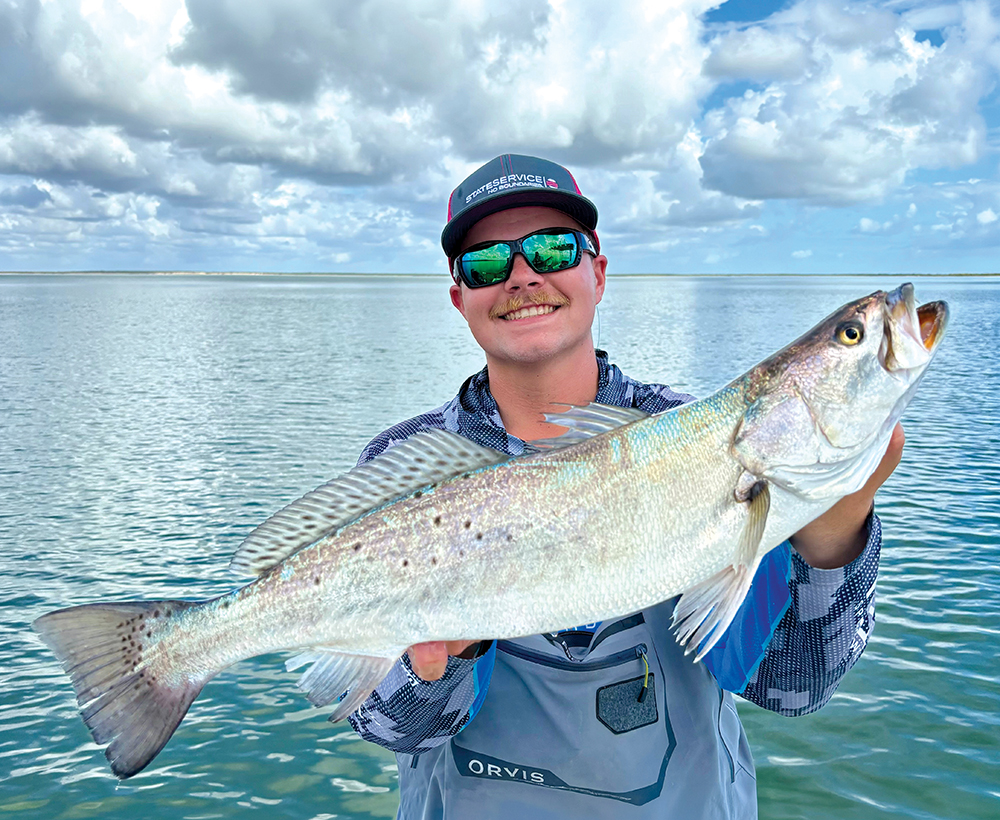
One of the best big trout days I ever had on the water was a forty-five-minute window one miserably cold afternoon on Lake Calcasieu where the water temps hovered in the low 50s and the air temps were barely 40°F. During that small period of time it was as if the fish were back in summertime feeding mode as the trout just went nuts on the topwater plugs we were offering. Just as quickly as it started, it ended just as abruptly. It was special and both my partner and I knew it. To go from not even having a bite for hours to complete chaos solidified my belief in the “window of opportunity” theory and I continue to use it today.
Now, when things go from bad to worse and the normal options like the open lake are no longer in play, it’s time to seek shelter and comfort in deeper water such as the Sabine River or Intracoastal Waterway. For years we have been able to escape the elements in these areas while still being able to catch fish on a consistent basis.
The deep-water pattern is a mystery to most folks, but it doesn’t have to be. Normally you take an average angler and put them in water deeper than 8 feet and they struggle, so the prospect of fishing in 15- to 20-feet feels like learning a new language or doing calculus in the dark. Yes, it takes a little effort to figure the techniques out but once you get a feel for it, the rest is icing on the cake.
Easily the best way to attack the deeper stuff is with a swimbait; the action is built-in and that takes a variable out of the equation. Make long casts up-current and allow the bait to fall until you reach the bottom. As the bait falls you can count down until it stops and that will help you with depth control. If it takes seven seconds to reach the bottom you can count to five or six in order to fish a little higher in the water column and so forth.
Crankbaits, both lipped and lipless, will be great choices in these areas as well. Vertically jigging soft plastics is perhaps the most underrated approach to fishing deep water for speckled trout, but it’s an absolutely fantastic option. Probing deep water isn’t for everyone but it sure beats not fishing at all. Once you become proficient at this style of fishing you can save yourself days on the water that you normally lost due to bad conditions – plus you won’t have any traffic around you because the regular angler won’t attempt the technique.
Understanding the options and preparing for the elements is a must in order to be successful this month so do your homework and prepare to safely enjoy your time on the water. As always, if you get the chance, please take a kid fishing and share the sport with the next generation.