
Is November the New October?
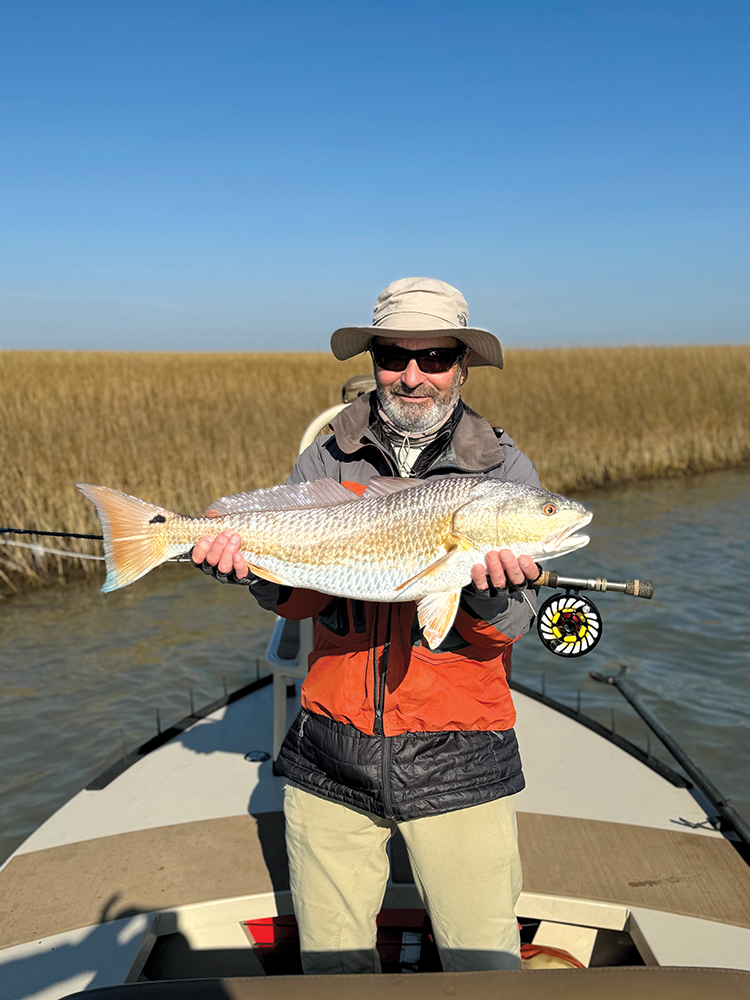
The last few years it seems like fall has been running a few weeks behind. Leaving question whether the season itself still actually exists or if we’re only left with a second summer and pumpkin spiced everything. I’ve heard several complaints about this, and I’ll admit I’ve made a few myself, but after some thought I’m not sure it’s necessarily a bad thing for our sight-fishing program. Let me explain.
Our upper coast marshes go through a cycle this time of the year with heavily fluctuating water levels, both wind and lunar driven. These strong-flushing tides create a phenomenon that sight-fishermen look forward to all year long – big schools of gorge-feeding redfish. The redfish show up to feed in masses, knowing their favorite forage is going to be flushed out of their spartina grass homes right onto their dinner plates. Shrimp, and lots of them, ride the falling tides on a one-way ticket to the gulf before winter arrives, and redfish gladly take advantage of the all-you-can-eat buffet. The milder the fall season might be, the longer this phenomenon can play out. If we have a couple of hard-blasting cold fronts by early November, then that could be all she wrote, and the shrimp are long gone. However, during these mild fall seasons like we have become accustomed to the last few years, I’ve seen these patterns play out well into December. Thus, why I am no longer complaining about our delayed fall season.
Another phenomenon this time of year is that the water in our marshes becomes much clearer. This change in turbidity I believe occurs from a combination of things like colder water temperatures, and typically less freshwater runoff that in turn makes for less algae suspended in the water column. While hard winds and fast outgoing tides can dirty the water with sediment, it doesn’t take long to settle back out. This cleaner water tips the advantage in our favor as we can see fish much deeper than during the summer months.
For example, oftentimes, as you approach a marsh drain, a fish will pick up on your presence and try to slip away down the edge of the nearest gut. A move that typically works for them in the warmer months, but now with visibility of two feet or more you can see their attempt at escape and slip a cast right in front of him to make an offer he can’t refuse. It is in this season that I feel we get to even the score.
Cleaner water throughout the marsh is a huge game changer for us on the upper coast because it allows for sight-fishing possibilities at any tide level. Even those pesky tides between 1.5 and 2.2 feet, like we’ve become so accustomed to fishing this year. Don’t get me wrong, I’m still not a fan of those water levels but at least there’s some options this time of year.
Locating redfish this time of year is pretty easy if you know what to look for. I like to run up to the opening of a shallow lake or marsh and shut down to observe the area from afar. You do not want to just blow through interior lakes this time of year as there can be schooling fish where you might normally run right through, especially on days with strong outgoing tides. Once in a good position I’ll scan the lake looking for nervous water and low hovering gulls. If it’s a big area, binoculars are a good idea. I feel like this method gets you on the fish faster and cuts out hours of poling empty shorelines. The fish and birds give easy visual clues for those who slow down to observe. Sometimes I feel like my clients think I’m a bit bonkers when I sit at the opening of a lake and stare into the abyss, and then leave the area without fishing it, just to repeat the process two or more times. But they don’t complain when there’s a fifty-fish school mere feet from the boat.
Once I locate a school of fish, I’ll decide if I need to motor closer or pole my way to them. The direction and strength of the wind are often the determining factors. If the wind is blowing in your face and the fish are traveling into the wind you might need to get a little closer before poling.
The speed the school is traveling can be a factor as well. Generally, I try not to run my engine within 100 yards of schooling fish. Your approach with the boat while poling can make a big difference as well. I try to pole just slightly slower than the fish are traveling. Poling slower pushes less of a pressure wave off the boat and gives you the element of surprise. I struggled to understand this in my first few years pushing a boat. I wanted to get to the fish as fast as possible but then couldn’t understand why the school would vanish before my angler could get a cast off. Some days the fish are more sensitive than others. Reading the reaction of the school as you approach will tell you quickly if you’re making too much commotion.
In closing, November truly is one of my favorite months of the year on this beautiful Texas coastline. I don’t know if there is another month with more consistent sight-fishing opportunity than this one. Big outgoing tides hit like clockwork and if any of those can coincide with a light north breeze and sunshine, you have a sight-fishing trifecta. If all the stars don’t align for those conditions, trout fishing usually starts to get interesting this time of year as well. While I don’t typically guide trout fishing trips, make no mistake, I haven’t forgotten how a plug rod works. With that said I’ll leave you with the words of the late Flip Pallot, “More to come, bye for now.”