
Mid-Coast Bays: July 2026
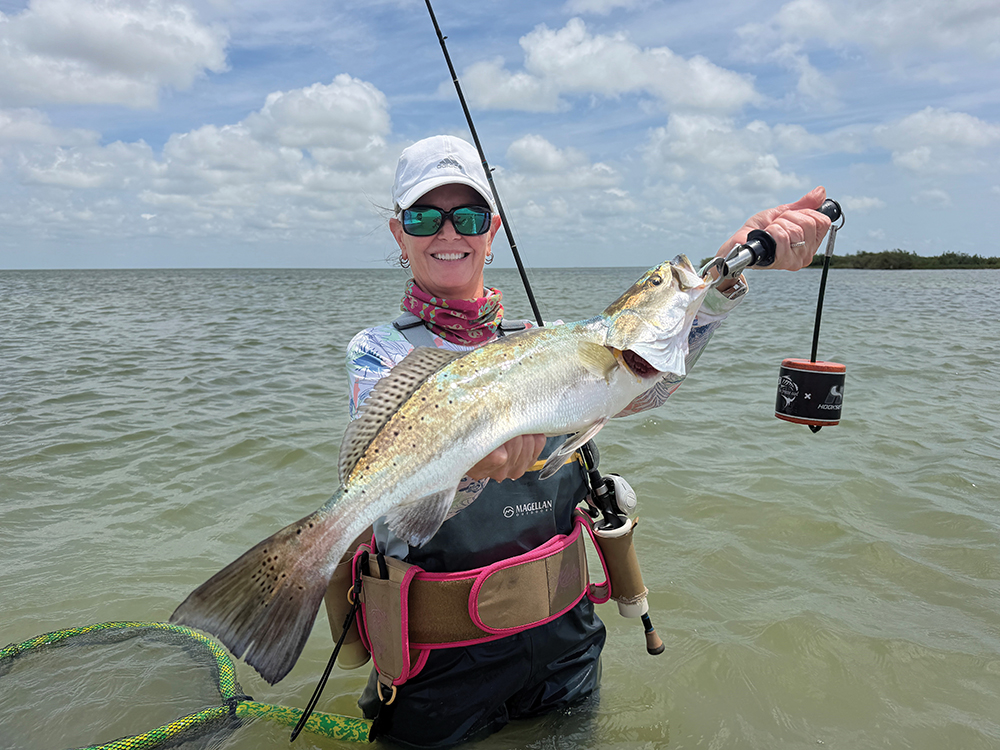
Kellie Holley put in the work and earned this beautiful catch.
Things are looking very promising here on the Mid-Coast as we head into our summer fishing season. Over the past couple of weeks we have received generous rainfall in our area and we are very thankful it came when it did. Every bay system along the coast needs freshwater inflow to help balance salinity levels and it looks as though the amounts received lately will help restore that balance after some serious drought conditions during the past year.
July’s calmer winds open many doors when it comes to planning fishing activities. Not only do the winds remain reasonably calm but the direction will be consistently southeast. The possibility of early-season tropical weather activity will be one of the few things that might disrupt that pattern.
Matagorda, Espiritu Santo, and San Antonio Bays have hard, sandy shorelines with patches of seagrass and deeper guts. San Antonio also has some of the best-producing mid-bay oyster reefs of the entire Texas coast. These are the areas that fish will migrate to this time of year in search of not only bait, but also deeper and cooler water, while our light summer breezes help ensure the water remains sufficiently oxygenated.
As of late, wading waist-deep or anchoring along drop-offs adjacent to deeper water have been one of the most reliable keys to catching. Holding steady when you find a decent bite is imperative to staying in the fish. I watch too many anglers unknowingly walk forward as they reel in a fish. After a few fish the angler has inadvertently wandered into the area where fish were staged and he had been catching them. Naturally, the bite shuts down because of this.
This can be a real headache if it happens to be one of those days when it took hours to find the bite, only to lose it shortly thereafter because of this scenario.
Another scenario that shuts down a bite quickly is having a shark or two crash the party. I have no science to explain it, but I can definitely say sharks in our bay waters now seem more numerous, and certainly more aggressive, than I can ever recall in the past.
In years past, most sharks that I encountered were easily spooked away when I would slap the water with my rod. Now it doesn’t seem to faze them whatsoever. Because of this I have gone from using a shorter stringer to using a long stringer, like ForEverlast’s 15-foot G2 Pro Stringer. Do not tie your stringer to your body or your belt. Instead, attach the stringer only by slipping the metal spike into the small holster on your wading belt. Some anglers prefer to wade with fish bags, but I have seen too many anglers get pulled backward and down by sharks trying to eat the fish inside the bag.
You also don’t want to go without your protective stingray gear. I sometimes wonder if the abundant numbers of stingrays aren’t a big part of the reason the sharks have become more numerous in shallow water. Good protection from stingrays is strongly advised. I personally don’t leave my boat without my ForEverlast Ray Guard Shields placed over my Southerly wading boots.
The mid-bay reefs in San Antonio Bay have been producing some nice trout catches in the last couple of weeks. You may have to do a little reef-hopping some days, but I can assure you it is worth the hunt. Before deciding to fish any reef in San Antonio Bay, make sure there is bait present. Birds working over and along the reef are also noteworthy because it is no secret; there will be fish underneath. However, in our neck of the woods, if those birds are not tight to a reef, be forewarned that the species under them may not be the ones you’re hoping for – small trout, ladyfish, and gafftop are more than likely what you’ll find.
Our trout numbers are looking strong so far this year. The reduction in bag limit to the present three per day per angler, along with the 15- to 20-inch keeper slot, enacted back in March 2024, seems to be helping the numbers rebound. I think in a couple more years our trout fishery will be even far better than we are enjoying today.
I shouldn’t have to remind you that July is one of our hottest months, so getting an early start in the morning can be the key to catching versus just going fishing.