


My Grander Mission
This has been an odd year for fishing the surf in Texas. The strange events started during late-spring, with the onset of strong winds. Consistently high wind speeds on a southeast heading are not unusual for Texas during the transition from spring to summer, but this year, the winds continued howling right on through June and July. When heavy rains inundated deep South Texas and northeastern Mexico, runoff filled the Rio Grande, which then dumped the cooler water into the Gulf. The persistent winds blew the dirty, relatively chilly water up the coastline, into the surf zone fronting Padre Island.
As water temperatures plummeted to ten or fifteen degrees below normal summertime averages, fishing for big sharks slowed to a crawl for folks like me, who normally catch plenty of oceanic monsters during this time-frame. Our larger apex predators, including tiger sharks, hammerheads and breeding bull sharks all tend to avoid the cold water upwellings, preferring warmer, less murky waters farther from shore. If the events linger, some of the brutes move north and show up along the beaches from Mustang to Galveston islands. This year, some of my friends and fellow anglers began catching monsters in June on those stretches of our shoreline. Meanwhile, the waters fronting the beaches of Padre Island National Seashore produced a seemingly infinite supply of gafftops and hardheads.
The dark cloud of these cold water anomalies does have a silver lining, though, which revolves around a single shark species. Here in Texas, anglers usually land a decent number of large dusky sharks during these events. Florida anglers catch dusky sharks during winter, often along with makos. But here in the Lone Star State, we don't see them then, and in normal years, with warm, relatively clear water along our beaches, we often don't catch any during the summer months either.
Thankfully, this year, because of the severity and duration of the upwelling event, we caught about as many or more dusky sharks than ever before. Several of my buddies fought and landed some real beauties, but in the end, we all yearned for a return to normal summertime conditions and an increase in our chances for tackling the beasts which traditionally fill our summer nights with thrills. By the end of July, we finally saw light at the end of the cold tunnel. When the water cleared and warmed up to normal temperatures, big sharks moved back in to our target zone.
In August, just in time for our peak season for targeting monster tiger sharks, conditions returned to a normal state. At this time, the Harte Research Institute contacted me about helping to get a satellite tag placed in a tiger or hammer for the CSSC. I got a tag in hand and in between charters ran down the beach for a night with a friend, after obtaining some fresh-dead southern stingrays to deploy as baits. Normally, I'd have preferred cownose rays, but this year, they've been scarce.
At first, our spread of juicy southern rays garnered no attention from sharks of any kind. I began to wonder whether I should have fished farther to the north. Then, right around midnight, something picked up one of my baits. Because of the constant "slow roll" with which it fought, I knew I'd hooked a tiger. After a fairly short fight, I succeeded in landing the ten footer and successfully deployed the tag in her dorsal fin.
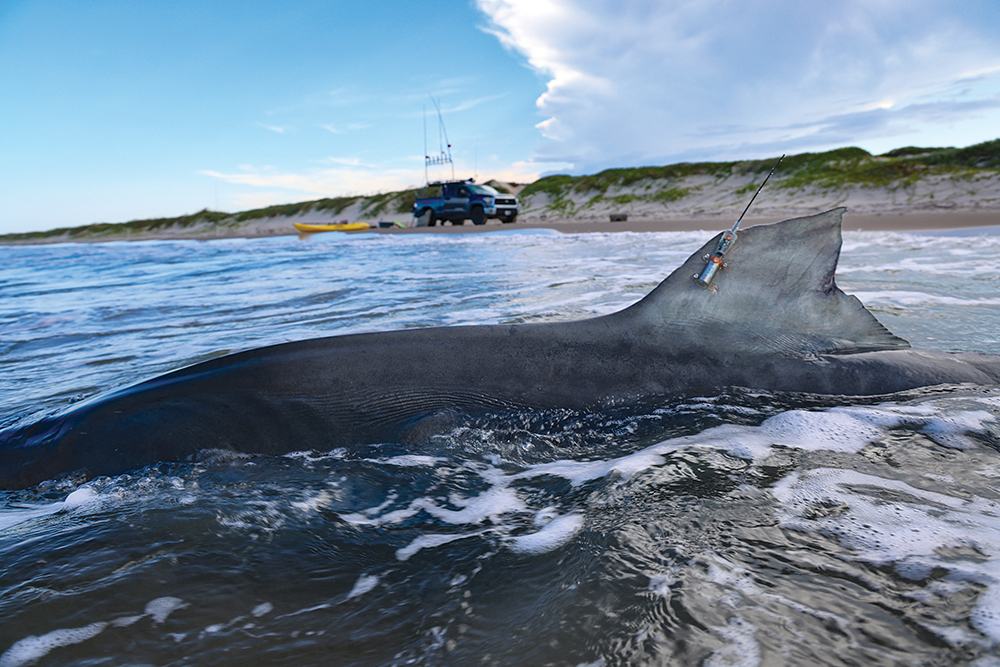
These tags are meant to activate when submerged in water. They then transmit data to satellites when the dorsal fin breaches the water's surface. With this data ping, as it’s called, people monitoring the satellites are able to track the shark's movement patterns. I was stoked to catch, tag, and release this tiger, my first of the season. All of this was satisfying, but a ten-foot tiger is not huge. Deep inside I craved a battle with a bigger beast.
A week later, I was asked to try and get another tiger tagged and, of course, I accepted the challenge. After obtaining a tag, I found a window of opportunity when a charter had to be rescheduled. I stocked up again with southern stingrays averaging about twenty pounds and headed back to a sweet stretch of beachfront. I cut them diagonally so each ray would provide two baits and deployed them out as the afternoon sun began its descent. Magic happened at about five o'clock. A shark picked up one of my rays about 450 yards from shore and began a slow roll, heading offshore like a long, strong train.
Again, realizing the predictable nature of its fight, I knew I'd hook a big tiger. I grabbed my Ozmosis shark rod and 80W Alutecnos reel, harnessed in and jumped into what I knew might become a long battle. Repeatedly, the beast dumped a couple hundred yards of line off the reel before I could turn its head and win some back, only to recover and dump more line again. This pattern is typical for a big tiger. Sometimes, the slow, steady nature of their fight fools us, as we think all is well until we see how little line is left on the spool of our reel.
About half an hour into this fight I finally began to turn the shark and make real headway, regaining most of the line I'd lost. I knew I had to keep the shark from tangling my other lines and I had no one to help me. However, having landed many giant sharks solo over the years I felt confident I could win the battle and tag this monster. When the tide peaked, nearly an hour into the fight, I dragged my tiger onto the second bar, and the line fell slack.
My heart sank, and I thought my line was cut. Still, I continued to crank the reel handle, hoping for the best, and eventually I felt tension again. My adversary had turned and swam toward me, cruising all the way over the first bar, practically onto the sand of the beach. I jumped off the platform atop the truck and ran out into the water, carrying a tail-rope. As I approached, I could see the immense size of the shark, so I decided to leave her in the wading gut, which worked perfectly. I took my measurements and attached the tag to a specimen with a dorsal fin which had healed after being cut. This meant I had to place the tag closer to the body than normal.
To execute a successful release, I took advantage of the high tide, and moved the now alert and upright fish over the first bar without any problems. From there she simply swam away from me into the inky abyss. This monster measured 12'8" and weighed an estimated 1000 pounds, bettering my previous personal best tiger by six inches. Having landed another 12'8" tiger for a customer, I can honestly say these are the most impressively massive creatures we encounter on our beaches. To say the least, I was stoked about how smoothly every part of the process of tagging and releasing such a beautiful creature went. Catching any shark of such magnitude would provide ample satisfaction, but after dealing with the slow bite in the ugly, cool water for most of the summer, fulfilling my grander mission tastes especially sweet.