


Risks and Rewards
The summer of 2026 has been an unusual season in the surf of south Texas; El Nino has definitely disrupted our normal patterns and routines. Relentless south and southeast winds pounded the coast, wrecking the water clarity for long periods of time. From the Rio Grande up to the Coastal Bend, the strong winds sent currents racing along the shore.
This current carries water from south to north along our coastline, causing upwellings of cold water in the middle of our hottest months. If prolonged for several weeks or more, this pattern can become a significant detriment to our fishery. On Padre Island, we've endured these cool, dirty upwellings since June; the patterns persist as I type, in early August. This is by far the longest stretch I've ever witnessed with this unwelcome anomaly. Nonetheless, hard times on the beach coexist alongside some rare surprises.
The problem this pattern creates for beachgoing anglers starts with the fact that many fish completely avoid the ugly, cold water. Some species get pushed out to deeper water; others run to the Upper Coast in search of greener water. Shark species like tigers and hammers will flee the upwellings in search of more normal water. So, we lose most of the fish we target in a normal summer.
This season, we've endured the effects of another destructive nemesis. Along most of Padre Island, I've witnessed an invasion of juvenile ribbonfish in the surf. Their presence has attracted all kinds of birds, who wind up eating them and fighting over them. These slender, silver fish are top predators in their own right, ferocious for their size.
They cause us big problems when floating debris like seaweed carried by the current gets hung on our lines. The ribbonfish then slash at it, thinking it's prey, and their rows of razor-sharp teeth often cut our lines. For the last two months, I've endured these attacks on a massive scale, with roughly 75% of the lines I've had out for sharks cut by these menacing critters.
The combination of the ugly water and the pesky ribbonfish can make us feel like it's not worth fishing the beachfront, but the main reason to keep running baits out into the dirty water is to take advantage of the rare surprises it can provide. We don't catch many dusky sharks from our beaches; the few we do land always ride in with the cool currents associated with these upwellings. A dusky shark is an impressive animal, resembling a 500-pound, 10-foot blacktip on some kind of steroids. Pound for pound, these are some of the strongest fish on the planet. I know because I was blessed to land one of the largest duskys ever caught in Texas.
We also have some sandbar sharks swimming around during events like these. Normally, the species is present only during the winter months, sometimes also early in the spring. But when the cold, ugly water rolls in, some sandbar sharks come with it. They provide us another target to replace our usual toothy suspects.
Another rare species can make its presence known during upwellings. Mako sharks show up in small numbers. This year, on the busy 4th of July weekend, the first mako came to the sand on a Texas beach. This rare occurrence certainly helps soothe the sting of the loss of so many other spectacular species.
During recent days, pretty water has crowded the dirty stuff close to the beach. The catching on my charters has been inconsistent, but promising. On one trip, a regular client from Austin came to the coast with high hopes. No stranger to catching big sharks; Jeff had already landed a massive 12-foot tiger while fishing with me. When I watched the relentless winds let up quite a bit, I knew we'd have a short, but promising window in which to catch a tiger. When we put out baits, I knew we could see some good results, as we deployed them in some green water a few hundred yards from shore.
With shark baits out, we started trying to catch baits in the cast net. We ended up with some small whiting and experienced a slow bite when we cast them into the dirty water closer to shore. While working through this, we heard a clicker start going off on top of the truck. One of the shark rods went off, and the reel sounded like a racing Harley. The monster generating the noise had picked up a cownose stingray and was blistering through the water toward the horizon.
Jeff battled this true sea monster on the Ozmosis rod and an Alutecnos 80W reel. For the first few minutes, he could do little more than watch line disappear off the reel. After a few more minutes, the shark slowed and started to turn. I told Jeff, "This is your time." With the shark swimming toward us, keeping pressure on the line became imperative, to prevent the hook from popping out. Being a fairly experienced angler, Jeff battled the shark with precision.
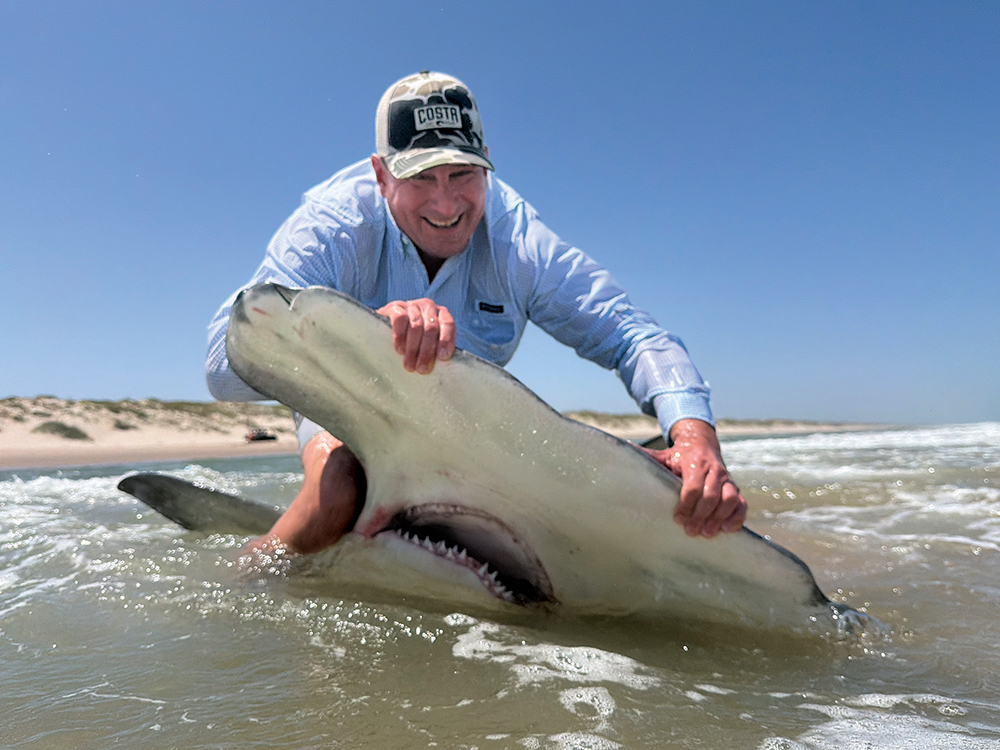
We strongly suspected we knew what kind of shark it was, but for a while it stayed deep, refusing to come to the surface and confirm our suspicions. When Jeff succeeded in pulling the beast onto the second bar, we confirmed what we believed to be true. He had nearly tamed a massive great hammerhead. The speed of the original run made by this fish resembled those made by many others I've caught and witnessed; they're truly speed demons.
Our good luck continued when the shark crossed the bar and I was able to subdue it with the tail rope. I got the shark situated, executed an easy removal of the hook, then made some quick, accurate measurements. At 13 feet 5 inches in length, Jeff's impressive adversary weighed close to 900 pounds. After a few snaps of the camera, we helped the shark out to deeper water, so she could swim away from us, back to the depths from where she came.
Strangely, the shark was really thick, either super fat and healthy, or pregnant. Normally, the great hammerheads give birth sometime in June. Maybe the El Nino cycle delayed her birthing cycle. It's hard to say for sure. We do know the massive shark did much more than just make the trip worthwhile. For Jeff, she represents the catch of his lifetime, and she's one of the largest sharks landed on the Texas Coast this year.
Such a catch would be welcome any year, but in a crazy summer like this one, it feels even more significant. I'm hoping we get some kind of moderate tropical event soon; cyclones usually reverse the effects of the cold upwellings. Even if nothing changes, we'll continue dealing with the conditions we've got, hoping to experience something rare and amazing in one of the least predictable, yet most rewarding and surprising fisheries on the planet.