
Salty Innovation
The more experience we obtain on the water, the more ways we seek to do things more effectively and efficiently. The evolution of fishing technologies and gear has largely proceeded on a steady curve, driven by the anglers themselves. Most skilled anglers come up with objects and/or methods that enhance their chances at consistent productivity.
Some create lures, some make their own leaders, and some build their own rods. I've created unique leaders, poured my own weights, made custom offshore lures and jigs, designed and built rods and much more. I've done all these things, embracing this sport with creativity fueled by the desire to excel. I see these acts as a natural way of expressing creativity and fulfilling potential. To this very minute, I'm involved in making innovations in my fishing world.
In my youth, I lived in Central Texas, but I made many trips to the coast to explore the sharking game. During this time, I started to learn to construct my own entry-level shark leaders. During the week, I would make a trip to the local Academy store and buy the heaviest leader material and biggest hooks they had. Then I'd spend weekdays building leaders. Most weekends, I raced down I-35 straight to the Gulf. I did this consistently for a couple of years, straight out of high school.
When I moved to attend college at Texas A&M–Corpus Christi, I fished the coast regularly. My focus was to expand my fishing potential to the max. In fact, the charm of the saltwater largely drove me to choose this great university. But fishing gear is not cheap, so I needed to find work to finance my trips. My first job in Corpus was working for mentor and good friend Nick Meyer at Breakaway Tackle. For a couple of years at Breakaway, I built their custom surf rods.
Throughout my entire life since graduating from college, I've devoted myself extensively to beach fishing. When I became a permanent resident of the Coastal Bend, my life changed and my focus on a lifestyle based on the celebration of saltwater angling intensified. To me, building a fishing rod is a way to express personality in a tangible and useful form. I love the work and also the looks on people's faces when they first see their custom rods. Over the years, I've built at least 400 rods, maybe 500—mostly during those early years working for Nick. I look back on the work associated with building those rods fondly. These days, I rarely build rods, but the entire experience truly played a foundational role in my fishing career.
As the years have passed, surf fishing has become an absolute priority for me. Soon after college ended, hyper-focused to an obsessive point, I practically lived on the water, regularly creating new stuff and new ways of doing things. On every trip to the beach I tried to optimize my opportunities. I utilized a lot of electrical tape on my leaders and zip-ties on my baits with the goal of making a natural, streamlined presentation which I felt gave me an advantage over other fishermen—and the fish. In this process, I created a method of fishing that resulted in landing my first surf-caught mako, truly the Holy Grail of shark fishing from the sand in Texas.
In addition to the innovations I made in leaders, I started vacuum-sealing shark baits almost twenty years ago—one of the first people in the Lone Star State to do so on a regular basis. The secret to the success of my sharking efforts starts with having the freshest, best baits possible. Over the years, I've vacuum-sealed thousands of shark baits, from stingray slabs to whole jacks.
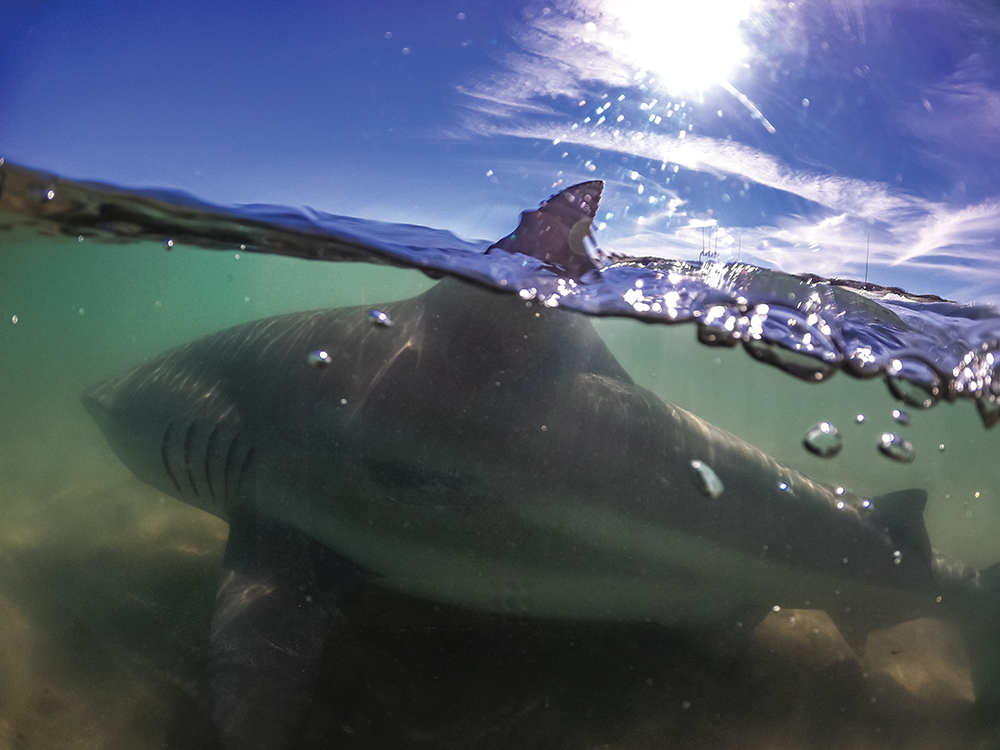
During a magical early decade spent on the beaches of South Texas, I caught monster sharks on a consistent basis. My life changed further when I merged my life in the sport into a career after Captain Billy Sandifer suggested I take over his shark fishing charters. From that moment to now, I've been dedicated to the pursuit.
Several years ago, I had a chance to obtain a small tackle company called Catch Sharks. When this happened, the doors in the creativity department of my mind opened and ideas flooded in and out. Eventually, I came up with something that makes me feel the best kind of combined pride and joy. The unique Tru-sand coating I created for the hooks and terminal tackle on the leaders I make for my Catch Sharks brand uses a custom sand-colored vinyl shrink coating over the sleeves and crimps, making them virtually invisible underwater. It's hard to know for certain how much of an effect this has on catch rates, but I firmly believe their stealth provides at least some sort of advantage.
I've recently come up with some new innovations. A couple of years ago, I designed the Ozmosis rod blanks for crafting shark rods that I now run exclusively in my lineup. Coming off that success, there are two newly released items I've spent a great deal of time perfecting. The first is a custom 3D-printed bait capsule, which I primarily use for targeting the big, ugly variety of oversized black drum in late winter and early spring.
Traditionally, we used half or whole blue crabs for bait when trying to catch these brutes. In years when we had warmer-than-normal air and water temperatures, we found ourselves overwhelmed by small fish when we used these proven baits. Sometimes pinfish and other small fish would clean all the meat out of a half crab in mere minutes. The bait capsules, which I dubbed Big Ugly Bombs, provide a protective measure against this form of fishing theft. These precisely engineered, permeable capsules can be crammed full of crab meat or shrimp with no fear of being stripped by hungry little fish.
The other unique item I'm currently releasing is a highly desired tool for heavy-duty shark fishing reels. I call this custom-engineered adaptive reel accessory used for bringing in and swapping out baits the Ozmosis Reel Boost (O.R.B.). Shark anglers deploy baits 400, 600, sometimes over 800 yards from the beach these days. When it's time to bring in a bait, an angler simply uses normal tension to break the spider weight’s grip free from the sand, then attaches the O.R.B. and drills the line in.
Utilizing the O.R.B. provides both a chronological and a physical advantage, eliminating lost time and energy in what has always been a painstaking process. It's important to note the reel must be in low gear and the drill must be at a low speed to do this correctly. In addition to changing out baits, this great tool works well for filling reels with line. At this point, I've made the O.R.B. compatible with Avet EXW shark reels and some 80-model Alutecnos reels, with other models being added to the line constantly.
Those of us who spend a great deal of time on the water often ponder ways to make the things we do easier, more efficient and more productive. I've been inspired to explore my creativity by the eccentric Nick Meyer, who continues to come up with interesting and useful innovations in the fishing world. With technology upgrading on a daily basis, gear and methods will forever evolve. I'll continue to adapt and contribute to developing trends in the sport. Our creativity is a valuable expression of our blessed freedom. As long as I'm able, I'll celebrate it by making new things and exploring new possibilities.