
September Swing
The month of September simply can’t get here soon enough. Summer has seemed to drag out this year with long periods of less-than-desirable tides and high winds. Combine that with the anticipation of waiting on my next Sabine skiff to be finished and time has been crawling. September should be the solution for my troubles. The fall equinox is on the 22nd of this month and always seems to bring us some higher tides. Although the equinox alone may not create a true flood tide it certainly sets us up for one. I’ve grown quite fond of fishing flood tides on the Upper Texas coast and this year, as of this writing, we haven’t had one for a prolonged enough period to properly fish it. When I first started guiding up here, I really despised these higher than usual tides. But as I slowly learned the nuances of how to find and fish some of the areas that produced at these higher water levels it has become something I really look forward to.
So, what makes a flood tide spot, you might ask? Well on the upper Texas coast, some of the better spots seem to be created by areas in the marsh where the spartina grass has died. Periods of prolonged high tides will trap water around lower-lying areas and the spartina basically rots. Why this happens I have no idea as I’m not a scientist. All I know is after an area of spartina dies the mud which was previously protected by the roots of the grass is now very vulnerable to erosion. Eventually the tide will cut a small ditch, which in turn further opens the area up essentially creating a small pond, but only at very high water levels. And, just like that, a new flood tide spot is born. I’ve seen some areas close back up and the grass grow back thick and strong, but more often than not once the area has a spartina grass die-off it only gets bigger and more eroded. This erosion isn’t necessarily a good thing for the marsh, but you might as well make lemonade out of lemons. It is important to not forcefully motor into these small delicate areas as you don’t want to accelerate the erosion by cutting a small wheel ditch with your propeller. If you can pole into and out of these areas; I don’t see any harm in accessing them.
The next thing I like about fishing these spots is that you often have them all to yourself as these spots are only found by putting in lots of time on the water. It is nearly impossible to scout for them via google earth because those images are almost always taken on a clear winter day where the tide levels are typically negative. Furthermore, these spots are constantly changing year to year so even if you find a good flood tide spot this year it may not produce two years down the road.
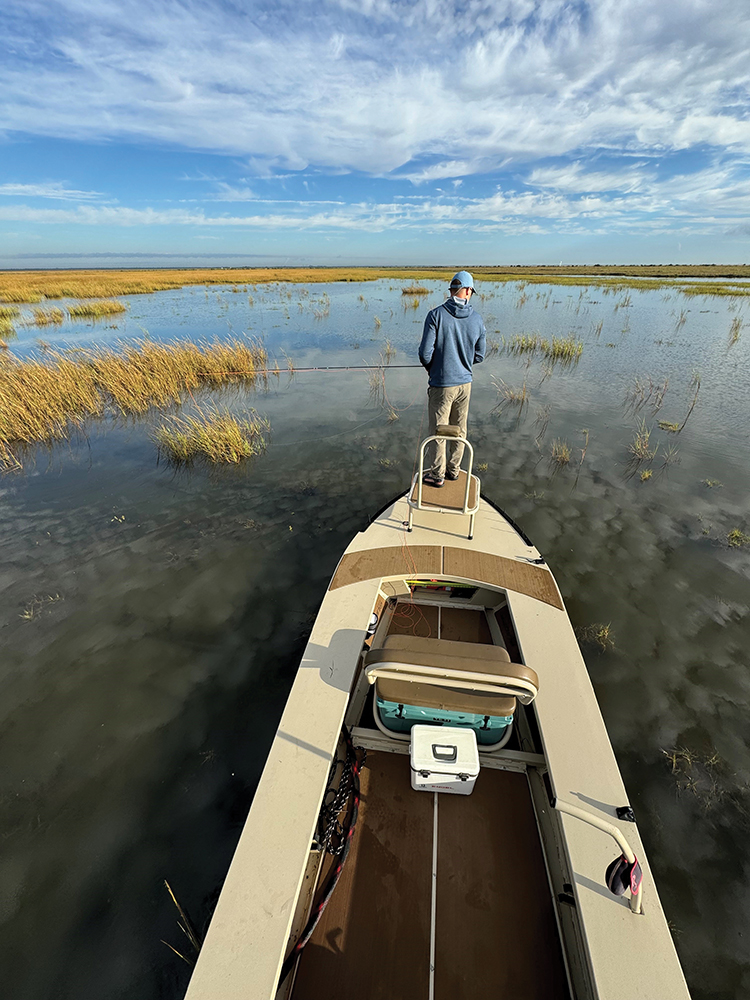
Another thing that keeps the majority of people out of these spots is it takes a special type of boat to access them. These areas fish the best when redfish can barely swim through them and often are one foot at the very deepest. I’d say the average depth for these spots is around five to eight inches, but you also have to pole around or over small mud humps and clumps of saltwort. Therefore, not only is a flat bottom poling skiff the right tool for the job, but a very shallow drafting micro-skiff, such as a Sabine Sneak 17 is possibly the best tool for it. This skiff is new to the Sabine line up and fills the void left by the Sabine Micro. It is a true micro-skiff pushed by a 30-horsepower tiller motor making it a very simple and light build. I would love to add one of these boats to my arsenal someday as I do miss my Micro on the flood tide days.
I’ve mentioned many times how the wind has a strong influence on our tides here and this is often the driving force that gives us these flood tides. Unlike our Carolina counterparts who can set their watch to a flood tide six months in advance, our tide needs a little bit of unpredictable help. A few days of strong northeast or east winds will typically do it, and it helps if high tide coincides with daylight hours. That being said, fly fishing out of a micro-skiff in a thirty knot northeast wind isn’t exactly ideal. The scenario we’re all hoping for is a calm, sunny day on the backside of that hard northeast wind – that’s when you can really enjoy a flood tide day. Sometimes, unfortunately, weather systems can quickly shift the wind in the opposite direction before it ever has a chance to lie. But that’s just the way it goes, and you just have to take advantage of the opportunity when it’s given.
When the stars do align and the above average high tide does linger around, I like to enter these areas as quietly as possible with a push pole. Then pause for a few minutes upon entering and observe. Since these zones are super shallow, the redfish will often give themselves away when feeding. Loud crashes and big wakes are a sure sign you’re in the right spot. Once I put a visual on the location of a few fish, I’ll make a game plan of the best route to stalk them. It really is like hunting fish in this scenario and likely why I’ve grown to enjoy it so much.
Although you can catch these fish with conventional tackle in this situation, my clients and I like to seize the opportunity with fly tackle. It’s such a close-quartered visual game in these zones that it’s hard not to. To see a bright orange redfish slide over a dark backdrop in six inches of water, and the white of its mouth flash open inhaling your fly twenty feet from the boat, is a visual that will burn into your memory for years to come.
Until next time, low winds and high tides.