
Sight-Casting For Upper-Slot Trout
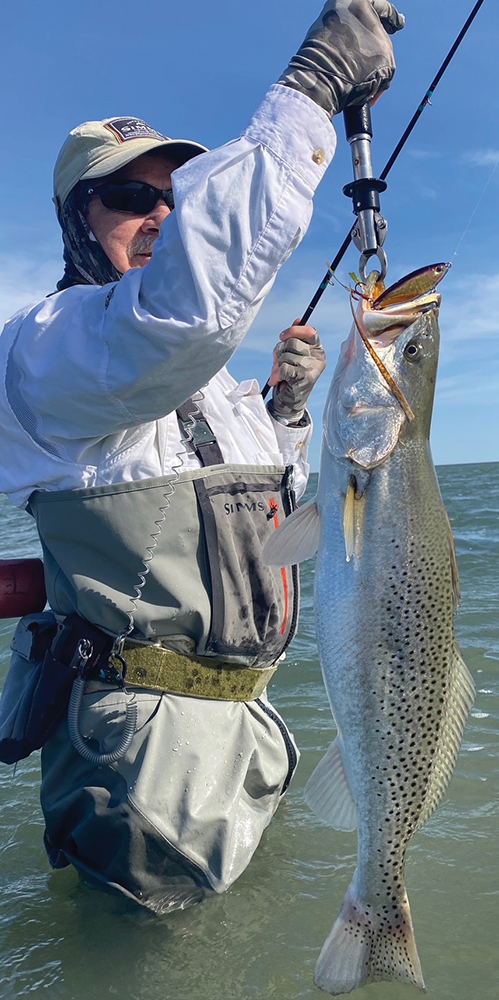
This month, I want to talk about some shallow-water tactics that I have confidence in using when it comes to catching the best fish that present themselves in the Rockport area. Rockport does not have the trophy trout reputation that some other areas in Texas own, but we do have some trophy-class fish here. Fewer, no doubt, than areas such as Baffin and the Upper and Lower Laguna Madre, but we still have a few.
May and June are great months to get up shallow and have some sight-casting opportunities with these larger fish. I know a handful of my fly-fishing buddies wait for this time of year to get a shot at some of the trout we get to see during this time of the year, and there is a growing part of me that believes that just maybe, chasing this class of fish in my area, one might be better suited to chasing them with a fly. Now—to get it straight right here in the beginning—I am not a good fly fisherman and I will absolutely not speak on anything fly fishing, as I could not possibly instruct anyone in this style of fishing. I can, however, tell you where they are and how to catch them on conventional tackle.
There is always the possibility that during the month of June we will begin to see the wind velocities backing down. I tell folks that our winds along the Middle Coast typically decrease dramatically after the Fourth of July. We do, however, experience periods in late May through the month of June when we will wake to nearly dead-calm conditions, and this presents the opportunity to work the mid-bay reef structures that lie north of Marker 25 in our ICW.
Now, as appealing as those reefs can be, I would actually prefer to concentrate my efforts on windward spoils and shorelines, when clients are capable and willing, searching for that very small percentage of upper-slot trout that will sometimes stage there.
Think about this. For at least three months straight, predominant SE winds have pounded these windward areas, stacking water and baitfish up close to the shoreline itself. That shoreline is a wall that prevents the bait from being able to escape the pursuit of game fish. These are facts that many understand and put into use during the spring months.
Windward fishing patterns are well published and well understood by many and have proven to be consistent fish-producers for a long time, no matter what bay system you are fishing. However, as simple and well-proven as these patterns are, when the winds subside this pattern seems to go unnoticed for the simple reason that so many fishermen are of the mindset that when the wind subsides, bait will disperse and game fish will seek other areas to feed.
However, if some of the bait remains, so will a certain number of the predators. And herein lies the key to some of the best big trout fishing of the whole year and being able to sight-cast trophy trout. In this next paragraph, I will attempt to explain my mindset on this type of fishing, and I will also attempt to explain my approach and methods for getting these exceptional fish to eat for you.
During the period when the winds are pretty much sustained at 15 to 20-plus mph per day from virtually every point on the compass, waters along windward shorelines become sandy to downright dirty. This condition both protects baitfish and also leaves them more vulnerable to predation. Upper-slot trout take advantage of this and become residents of the area throughout these conditions. The above-mentioned conditions often result in reduced angling pressure due to poor water clarity. That is a mistake, just so you know.
Trout instinctively want to feed shallow, as it naturally reduces the size of the strike zone, significantly improving their success in getting fed. During this same time period, they also seek to spawn in shallow water, which makes a second reason for them being there. So, the way I see it, any time a calm wind period coincides with a favorable moon phase for spawning activity would have to be the best of the best circumstances if one is able to be on the water at such a time. Put that in your notebook.
Here is what I believe and what I try to take advantage of. When the winds subside, the water will often remain somewhat sandy for at least a day or two. This short window allows me to see the trout to some degree, maybe not too clearly, but they cannot see me clearly either. I get a limited number of days during which to put my clients in position to catch these fish before the water becomes too clear—provided they actually possess the angling skills to get the job done.
Sounds a bit harsh, perhaps, but it is just a fact that not all the anglers I am lucky to guide to these opportunities possess finely honed sight-casting skills. Anglers must approach these areas in stealth mode. Stomping around won’t allow you to get close enough to even see one, I assure you.
Cut the motor way out there and drift in. Be aware of everything in the water around you and be prepared to make short, quick underhanded casts if necessary. Small flips and pitches are an added skill set in this style of fishing.
Remember that the first objective of sight-casting is for the angler to be able to see the target. Please invest in quality sunglasses. You have lots of choices, so there’s no excuse for not owning a pair. I recommend WaterLand eyewear. After lens replacement surgery, I no longer need prescription glasses, so their Mineral Glass lenses are an ideal fit for me. Light, super clear, and extremely durable are what WaterLand Eyewear are all about. Suffice it to say that all the casting skill in the world is of no value until the target has been spotted…so, enough about eyewear.
Large trout can appear as darker gray or black silhouettes, slowly cruising shallow grass edges and potholes. Stationary trout of upper-slot size can many times be especially stubborn to get to eat. Trout that are moving and fish that have companions are typically higher-percentage targets. It is true, from what I have seen over my years, that the smallest trout in the wolf pack are typically the most aggressive. Target the bigger ones if you are hoping for a trophy.
Try to pay close attention to the body language of the trout as they cruise the shallow flat. You can learn a ton by just watching how they react to approaching changes in the bottom structure and even the water depths in the potholes as they maneuver throughout the area. Trout get “birdy” just like a good quail dog when prey is discovered. You will see their movements quicken and see the fins perk up as well. It is a sign of excitement and a precursor to a feeding event.
I tend to want to throw smaller lures when fishing this pattern. The MirrOlure Lil John is top of the list in productivity, castability, and durability. Over the past two years I have also become confident in the 6th Sense Party Paddle. Downsizing baits is not always a necessity; this is especially true during periods of higher tides and overcast skies. I know that these fish can be caught on just about all of one’s favorite lures under certain conditions.
Accurate casts are essential, and the quieter the lure’s entry the better. This is the reason I prefer 1/16-ounce 2/0 jigheads, or maybe even 1/32-ounce 1/0 jigs. Texas Customs makes the best jighead on the market today, in my opinion, and the 1/16-ounce 2/0 is my personal favorite.
I prefer boring colors for the most part. Molting is a favorite, as are Watermelon, Plum, Morning Glory, White, and Bone. I do like a lure color that allows me to track the lure throughout the cast. I also believe that when it comes to the action of the soft plastic baits, less can be more, if that makes sense to you. Slight, short but deliberate twitches that barely make the lure shimmer along the edges of grass and sandy potholes can be met with unusually aggressive strikes.
Good things happen to those who wait patiently!
May Your Fishing Always Be Catching
-Guide Jay Watkins