
Summertime Tripletail
During summer breaks back during my high school years, when my buddies and I were not doing part-time jobs to earn extra money, we were almost always on the water somewhere. We spent a lot of time up on Toledo Bend chasing bass, and often during evenings after work, fishing for trout in the ship channel around Sabine. A weekend finally came where we were gifted with light north winds, and I knew that we needed to be down in the surf at daylight. As we had planned, we were waist-deep throwing topwaters just before the sun came up. As the morning went on, we had several trout on the stringer when the bite started to slow a bit. My buddy decided to change lures and tied on a Norton Sand Eel. Not long after the lure swap he hung into a fish and it immediately began to pull drag.
My assumption was that he hooked a nice bull red, and I instructed him to just reel it up and I would grab it and unhook it. As he raised his fish, I reached down to grab it and was startled by the first glimpse. I told him that it’s dang sure not a red, but it might be a black drum. As he raised it up again, I jumped back and told him to drag it to the beach because I had no idea what he had. It was large but taller than long, with a mottled brown and black appearance. We questioned what it was and not knowing; we did what kids would do and just threw it in the ice chest. On our way home we stopped at an older coworker’s residence in hope that he might be able to identify our mystery fish. All it took was a quick glance and he declared it to be a tripletail; a very good eating fish. He wasn’t wrong and that was my first experience with the species.
Since that day these odd fish have become an obsession to me and some of my friends. Conversations of tripletail fishing usually begin in early April with requests for a spot on the boat when the time comes. I always tell them that we are still a few weeks out but not to worry; I’ll keep them in mind when the tripletail show up.
There are several things that have to be right in order to be successful when chasing tripletail. Most important of these is the weather as the majority of the tripletail we find are in the gulf, just off the beachfront. We patiently wait around all summer and watch the forecast, praying for a few days with light north wind. This will bring the green water all the way in to the beach, making fish much easier to spot.
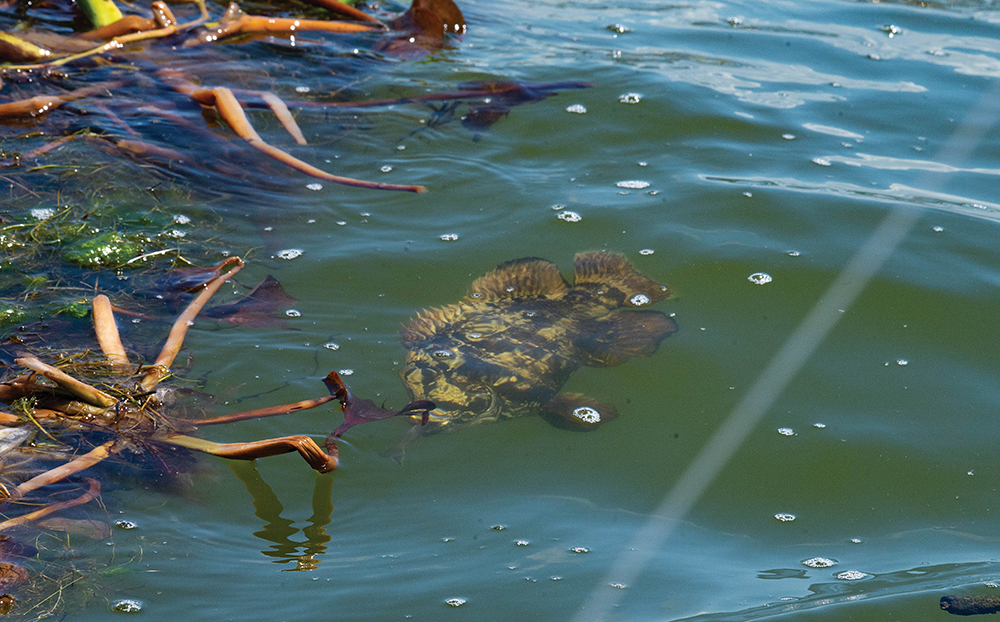
Once you have your weather window, the real tricky part begins. I strongly prefer sight-fishing for them, but I know they can also be caught by blind-casting. That being said, how do you find them? Well, you had better have a full tank of gas, a lot of patience, quality sunglasses, and as many eyes as you can get on your boat. These fish like to float on their side at the surface when they are not actively swimming, and also when they are feeding. It almost seems that their purpose in this is to trick bait fish into thinking they are merely another piece of floating debris.
The bait will hang around to seek refuge from predation, and that’s when the tripletail will collect an easy meal. They really are masters of camouflage; even to the human eye they look like floating debris or trash. The best way I can explain it is that it will look like a grocery sack or a clump of sargassum floating on the surface. No other fish I know of acts like ths and it really is a wild sight to see!
So, the next question is where to start? Well, there is a lot of water in the gulf and plenty of places to start. My personal favorite thing to do is drive through the jetties and head straight out about half a mile or so. Once out there I will begin to zig and zag towards the beach and then back out. What I am looking for is the tide line coming in from offshore. What we’re looking for is the characteristic hard line that forms between clean and somewhat dirty water. Most importantly though, that line will be carrying many types of debris – sargassum and other types of vegetation, small chunks of wood, cardboard and paper, to name a few.
Tripletail love to hang around anything that is in the water. So, what my day looks like is driving around until I find a solid rip line. I will then slow down and just cruise the outside of it, looking to spot a fish. It can be boring at times but very rewarding when it all comes together.
Once you have spotted a fish and verified it is not just another piece of trash, it’s time to get busy. Chasing tripletail is the only time that I ever allow live bait on my boat. We will typically stop at a store or bait stand that sells live shrimp and buy a quart, and we will present them by the freeline method. Casting as accurately as possible to get them close to the target.
The trick here is to figure out which way they are facing, cast past them, and then reel the shrimp right up in front of them. Once they spot it, they can’t resist it!
The most fun part of this whole situation is the 30 seconds of rush and panic once you have spotted a fish. You yell at your buddy to get a shrimp rigged up as you turn the boat around, never taking your eyes off the fish. When a good cast is made you get to watch that poor shrimp pop out the water, trying to get away, but it never does. It is a really exciting and fun chain of events.
Tripletail fishing can be a lot of fun, but it is not for everybody. It can be long days, burning gas and riding around under the hot Texas sun. But it can also be a whole lot of fun. It begins with watching the weather forecast for that perfect window that will provide a calm day or two and then being prepared to take advantage of it. Remember to bring plenty of water and provisions as it can be a long day. I promise you though, there’s nothing quite like hooking into a big tripletail, and the table fare they provide is an added bonus.