


The Beauty and Bounty of Summer House
In some ways, the area known as Summer House resembles the woman whose dwelling gave the place its name. Sarita Kenedy East maintained a cabin at the edge of the lagoon in this location; historians say she generally visited it during the summer months, most likely so she could use the cooling effects of the breezes, which persistently blow in this part of the world, to cope with the region's notorious, searing heat. The granddaughter of legendary cattle baron Mifflin Kenedy, who founded La Parra Ranch, Sarita was known as a generous philanthropist, a barona who consistently sought to ensure the health, education, and well-being of the Mexican-Americans who worked her ranch.
Sarita could stay in a saddle and hold her liquor better than most men; tough and shrewd, she also displayed a kind and sensitive side. The breadth of her influence on the culture of South Texas has staying power; she provided much to many during the days of her life and indeed beyond her death. Though little remains of the house she reportedly visited on the shoreline of what's now known as the Kenedy Ranch, the waters adjacent to the home site retain the stark beauty they displayed a century ago, and the area still possesses the potential to produce a bounty for coastal anglers who make the long run to this remote part of our coastal waterways.
Summer House has several of the attributes which define most supremely productive fishing holes. Lying alongside the Intracoastal Waterway, at the intersection of the Upper Laguna Madre and the Land Cut, two of The Lone Star State's premier big trout fisheries, this famous place has water of highly variable depths, three constituents cover the bottom, and adjacent land masses offer its waters protection from strong onshore winds. The breezes in this part of the state regularly whistle with enough intensity to wreck the water clarity in many parts of Baffin Bay and the Laguna Madre, but the long spoil island on the east side of the Intracoastal insulates the water on these flats from their effects, provided the breezes have some easterly aspect.
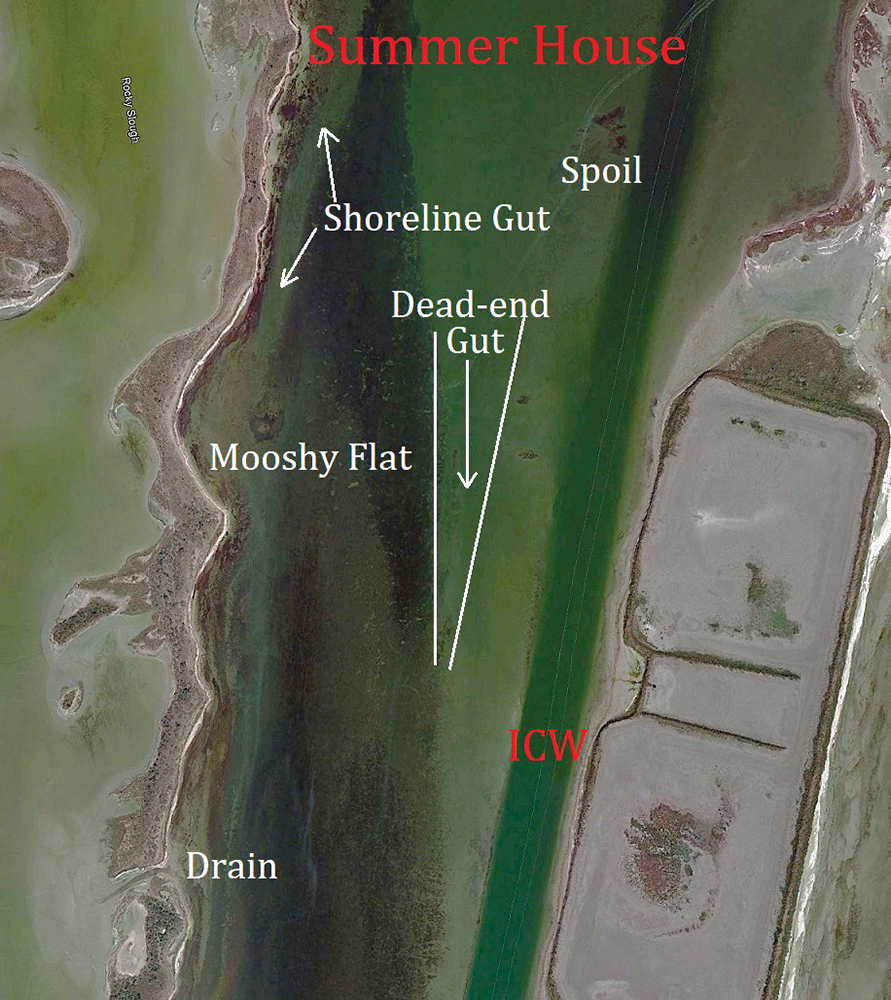
Basically, a broad, grassy flat serves as the foundation for Summer House. It measures about one-third of a mile wide, reaching eastward from the Kenedy shoreline to the sand bar lying along the western edge of the Intracoastal Waterway, and it's roughly a mile long from north to south, nestled into the northern entrance of the Land Cut. A wide, deep gut bisects the flat in the northern half of the area, and the flat becomes gradually shallower in its southern half. In its southernmost extremes, the Kenedy Ranch shoreline and a sand bar fronting it bend closer to the edge of the Land Cut and provide a metaphorical boundary for the spot.
Several parts of Summer House have longstanding records of excellent productivity for me and many others, mostly as places where one can expect to catch big numbers of speckled trout, including a few reaching and exceeding twenty-eight inches in length and weighing seven pounds or more. The entire span of the sand bar lying next to the deepest water in the area, in the Intracoastal itself, has the potential to produce plenty of fish, especially the isolated spoil in the northeast corner of Summer House. I and my customers have caught thousands of trout on this little patch of sand and grass, usually on hot summer days, with moderate to strong southeast winds whistling on our backs while we threw small topwaters and/or soft plastics rigged on eighth-ounce jigheads, either along the edges of the grass beds adorning the spoil or into the deeper water lying west and north of it.
In this same kind of weather, the best action, including the highest potential for catching some of the biggest trout in the area, often occurs where the deep gut bisecting the flat in the northern half of Summer House becomes shallower and plays out, surrounded by grass beds on all sides. This small pocket sometimes holds numbers of big trout, most of which lie in wait to ambush their prey in shallow water covering bright, silty potholes. This part of Summer House has the potential to produce a few big trout during any month of the year.
During spring and fall, as in the summer, the spot produces best during the early morning hours, when relatively quiet winds blow off the Gulf and onto land. Wading anglers standing to the east of the shallow potholes lying at the end of the big gut and casting topwaters and slow-sinking twitchbaits beyond and back through them sometimes find rich rewards. In the colder months, the area usually produces best from the time north winds fall quiet after the passage of one strong front all the way until onshore winds begin to ramp up with intensity in advance of the next front. Especially in the first half of winter, when trout often temporarily flee the shallows and retreat into water of greater depth while temperatures rapidly plummet, these shallow, silty potholes lie in a prime location. Anglers tossing soft plastics and slow-sinking twitchbaits into them during late-afternoon hours and into the gloaming could certainly catch the trout of a lifetime, as it prowls out of the depths looking for an easy meal without venturing too far from the relative safety of the warmer depths.
On the west side of the main gut bisecting the north half of Summer House, a slimmer, shallower secondary gut runs parallel to its bigger brother. A slender spine of sand covered by grass separates the two trenches. Certainly, the silty potholes comprising the secondary gut have the potential to hold plenty of trout, including some big ones, as does the spine, particularly its northern end. When the water runs clear here, anglers can see the spine well enough to wade along it from south to north, casting into both guts, along the edges of the spine, then concentrating on the northern tip when they reach it. This drill works best with wind speeds under fifteen knots in play.
Anglers also can and do catch some big trout around the rocks lying close to the bank on the Kenedy shoreline. Numerous rocks jut out of the sandy bottom right along the shore and in the muddy, grassy shallows slightly farther from shore. When light winds with a westerly aspect linger in the wake of a passing cold front, this pattern proves particularly productive for waders walking close to the bank. Some of the biggest trout caught by my customers in this area bit in this location during cold, relatively calm conditions.
In warmer weather, during spring, summer, and fall, anglers standing well away from the bank and making long casts toward the shoreline can also expect to catch plenty of trout around these rocks, especially those framing the end of a subtle gut running adjacent to the bank in the northwest corner of Summer House. Topwaters work best for this drill, eliminating the risk of snagging subsurface lures on the boulders. Wading this gut on medium-low and low tides works best, except for the tallest anglers.
Certainly, waders of all sizes can work the entire southern half of the area on foot. This mooshy flat has what I call boot-sucking mud on its bottom, so wading it takes strength and stamina, especially when one wants to move around without creating much commotion. Undoubtedly, some folks would benefit from making long drifts across this expansive flat so they can save energy and fish more safely. Anyone running a boat on the big motor in all parts of this area, especially on the shallows of its southern half, should do so only by idling. Several small clusters of rocks protrude from the bottom well away from shore in this place, posing serious risks to brave (a.k.a. stupid) anglers who choose to plane off and run around at full speed.
In southwestern parts of Summer House, a small drain funnels water in and out of a tidal lake known as Rocky Slough. Best I can tell from studying the Google Earth images and from walking briefly onshore to look around, Sarita Kenedy East's house stood just to the south of this drain. A set of old pilings runs off the shoreline here, likely ones driven into the bottom by ranch hands constructing a pier for their boss. The sandy, rocky shelf fronting this drain and the soft potholes and grass beds around these pilings have produced several big trout for me and my customers over the years, including a thirty-inch specimen Rick Brill caught a few days after my friend Jason King told me he'd caught and released a fish of the exact same size there. To this day, I believe they caught the same fish, as we could see a fresh handprint on its back while we took pictures and released it again. That trout bit a Paul Brown Fat Boy, as did many of the others we've caught in this picturesque corner of the lagoon.
In places with such shallow water, floating versions of those lures often work better than sinking ones. Without rattles and with an extremely slow sink rate, floating Fat Boys allow anglers to work their lures through the water at appropriate speed and with stealth. These facts prove quite relevant in the southern extremes of Summer House, where the bottom is mostly bright sand, covered only sparsely with small grass patches, at least most of the time. Anglers who manage to wade without making much of a ruckus, and those who have boats capable of drifting in really shallow water, catch a few giant trout by sight-casting in this part of the area.
Mostly, I think of Summer House as a prime place to target numbers of trout, including a few big ones, when winds howl off the Gulf and muck up the water in much of Baffin and the ULM. I have many fond memories of teaching customers to use Paul Brown Lures effectively in the spring and fall here. On some occasions, we caught more than one hundred trout a day in this little nook in South Texas, where a barona once liked to try and beat the heat.
In 1962, La Parra's queen crossed the gap into that last pasture; the sands of time have since erased almost all evidence of her getaway cabin, but some things endure in this region where so many acres belong to so few people. These famous ranches, almost as vast as the largess of the legendary landowners, partially insulate the public waterways they surround from the relentless, destructive effects of human encroachment. To this day, Summer House retains much of its natural beauty and plenty of potential to generously bless Texas anglers.