
The Great Eight and the Nearly Ninth
One can only catch fish on a lure one chooses to throw. Obviously, the opposite is also true. One cannot catch a fish on a lure one refuses to throw. So, anglers' choices directly influence the lists of lures on which they catch fish. Someone who throws a particular lure half the time should catch at least half their targeted fish on it.
I've pondered statements like the ones above many times in my career, and I've attempted to honestly assess how my preferences for certain lures have affected the number of big trout I've caught. As a young man, I developed a stubborn commitment to throwing full-sized topwaters. When I emerged as a competitive angler and guide, I began throwing slow-sinking twitchbaits a larger percentage of the time. My latest evolution involves working soft plastics into the mix more often, when conditions appear to dictate their use. I also dangle the worms under corks a decent percentage of the time these days, something I did not do years ago. With more experience, I've gained greater awareness of the value of versatility.
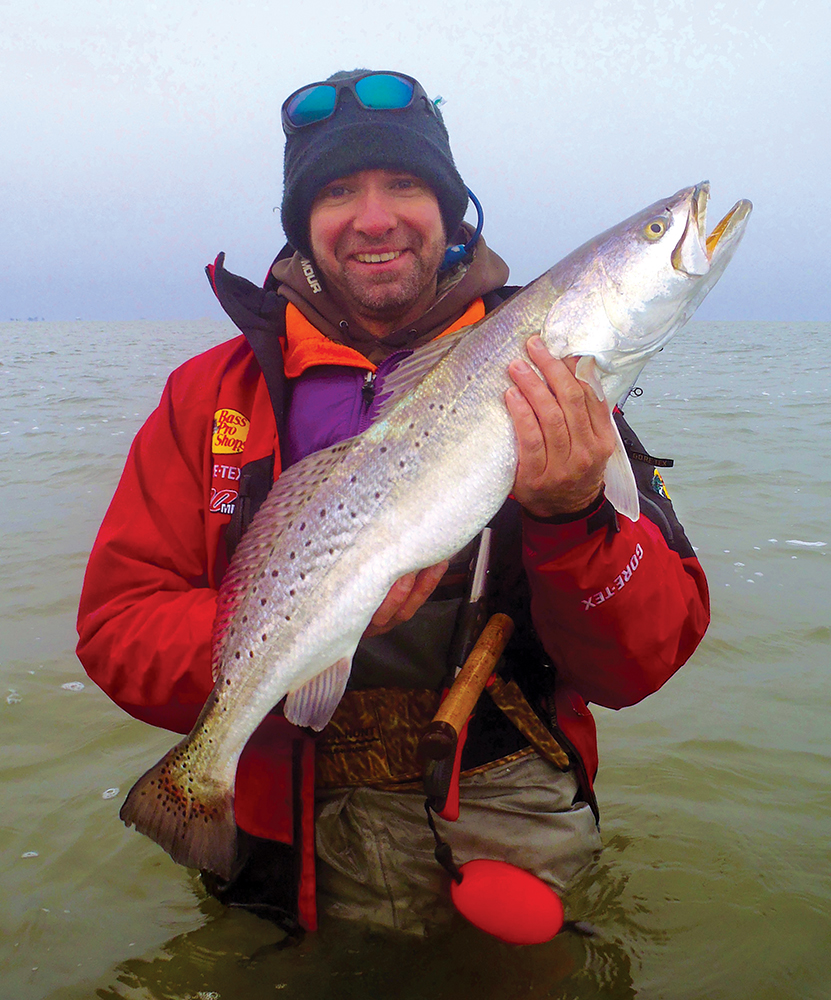
In the end, eight lures stand out among all the others I've tried, because of the results they've generated. I've caught trout measuring at least thirty inches on all the lures on this list; I've caught trout weighing at least ten pounds on five of them. Below, I name all the lures in the group I've dubbed my Great Eight, along with some pertinent facts about each. I also name a lure I believe should have earned a spot on the list, acknowledging it likely has failed to do so because I've used it far less than most of the others.
In February of 1997, I caught my first 27-inch trout on a Super Spook, in the back corner of a cove in West Galveston Bay. Later that year, at Trout Bayou in Aransas Bay, I caught my first 8-pound trout on one. These incidents elevated the hefty, cigar-shaped plug to the top of the list as my favorite lure. I threw the Super Spook a big percentage of the time in those days and caught quite a few other big trout on it, including my first measuring 30 inches, which I landed in the Badlands in the winter of 2002.
Over the years, I've become less committed to this lure, mostly because it requires one to expend so much energy during presentation. I've always thought of this classic, rattling topwater as versatile. It works in water less than knee-deep at times, also in water too deep for wading. In winter, the Super Spook works best during warm spells, in water ranging from the upper-50s to about 70F. It also works well during spring and fall, with water temperatures ranging from the low-70s to the low-80s.
The Junior version of the Super Spook is another lure which predictably finds a place on this list. I became a huge fan of the little plug after I learned how well it produces in hot water, when trout will strike topwaters on a daily basis. On many summer outings, I've used the Spook Junior to coax trout to blow up by working it erratically, adding pauses and speed bursts during presentation. Its diminutive size facilitates these movement patterns, allowing me to execute them without creating too much fatigue in my wrists and forearms. Most likely because I normally choose to use larger topwaters during early-morning hours, when the trout more readily strike lures moving slower and steadier, I've not caught lots of picture-worthy trout on the Junior, but I have landed trout measuring at least 30 inches on it.
Rapala's Skitter Walk, shaped more like a football than a cigar, also works well when worked fast, with erratic action. In 2002, I caught my first 31-inch, 10-pound trout on one, casting it into deep water south of the Tide Gauge Bar, in Baffin Bay. Because it rattles with a higher pitch than some other popular topwaters, I like the idea of using it to try and call trout to the surface in water too deep for wading. Like other floating plugs, the Skitter Walk works well in relatively warm winter weather and throughout the warmer months, even when water temperatures reach their peak at nearly 90F.
Paul Brown's Fat Boy, on the other hand, works best in cooler water, ranging from about 50 to about 80F. This shad-shaped, slow-sinking twitchbait will work in hot water too, though most folks disdain its use during the summer months. When worked with a rhythmic, dog walking action, much like a topwater, this lure generates strikes from big trout best in water ranging from about two to four feet deep. I've caught more magnum trout on this famous lure than any other, partly because of how much I throw it, but also because its attributes make it supremely effective for wading anglers targeting trophies.
I caught my longest trout ever in the North Badlands during the month of May on a Fat Boy, and landed another 32-inch, 10-pound trout on one while a January full moon reflected off the surface of clear water on the King Ranch shoreline. Surely, no other lure has made a more significant contribution to my reputation as a competent trophy trout hunter than this one. I'll never forget the day my late friend Jesse Arsola first placed one in my hand in East Matagorda Bay, nor the conversations I had with Paul Brown in his garage, when I went to his home to buy some of his lures, while I tried to master their use.
During the process of learning how best to use the Fat Boy, I also became aware of the Fat Boy Floater. In 2008, in water barely deep enough to cover my wading boots, on a shoreline in Alazan Bay, I caught the heaviest trout of my career on one of these. Over time, I came to understand something significant about the subtle differences between the floating versions of Paul Brown's lures and their faster-sinking brethren.
Because they have no rattles in them, and because they sink so slowly, Fat Boy Floaters work better in super shallow water, less than knee-deep, especially in clear water with light winds in play. Stealth in presentations matters most of the time in situations like these, and floating versions of Paul Brown's lures facilitate presentations which allow anglers to move the lures over bottom cover in shallow water at appropriate speeds, without creating too much commotion. I consider Fat Boy Floaters and Original Floaters interchangeable; I can't think of a situation in which one would significantly outperform the other. My preference for a Fat Boy over an Original is purely personal.
I have caught monster trout on the sinking, rattling version of Paul Brown's Original Lure, still called a Corky by many Texas anglers today. In Baffin Bay, Jim Wallace caught the then state-record trout on a silent version of the Corky in February of 1996; Paul made the lure without rattles back in those days. By around the turn of the century, Mr. Brown put rattles in all sinking Corkys and Fat Boys; only making the floaters without rattles.
Over time, I came to view the Corky as a specialty lure, and I've used it in a specific type of situation to catch good numbers of big trout, up to nearly 32 inches. By bending the tail of a Corky sharply down, to nearly a 90-degree angle, then retrieving the lure with sharp, short snaps of the rod tip, one can create a presentation which causes the lure to spin. This circling motion keeps the finger-mullet imitator down in the water when wind speeds ramp up over 20 knots. Trying to keep a Fat Boy under the tops of the tall waves generated by howling winds proves nearly impossible, but a bent Corky stays down in the strike-zone, even when winds scream loudly enough to make it hard for anglers to hear their own thoughts.
A MirrOlure Catch 5, on the other hand, works best in calmer conditions. I've caught quite a few memorable trout on these hard, noisy, flashy plugs, which I think of as the She Dogs of the sinking twitchbait family. I caught a 10-pound trout on a Catch 5 in February of 2014, while fishing the rocks at the west end of Cathead. That day, I chose it over a Fat Boy specifically because we fished in water stained by brown tide. The raspy pinging noises generated by a Catch 5 appeal to me in murky water. This lure works best in the same depths as a Fat Boy but becomes preferred when winds whisper over stained or turbid waters, especially when bright sunlight flashes and twinkles off its sides during vigorous presentations.
Anglers dangling soft plastics under small corks also coax strikes from huge trout in murky waters. The last lure on my list of eight great ones is a 5-inch MirrOlure Provoker, on which I caught a 10-pound trout measuring nearly 32 inches in 2015, in super shallow water severely tainted by brown algae. The long, slender tail of this soft plastic generally makes it most effective in clear water, when used without a cork. Rigged on a light jighead under a Comal Tackle Factory cork, it becomes capable of urging strikes in water with nearly zero visibility. I haven't caught as many giant trout on this lure as I have on larger lures which better mimic pinfish, shad and finger mullet, but my preference for those lures does exert influence this fact.
Again, one cannot catch a fish on a lure one does not throw. Predictably, I've caught fewer whopper trout on lures like the Provoker and Corky than on the lures I throw more often―the Fat Boy, Fat Boy Floater and Catch 5. The overall number of times I've thrown a One Knocker compared with my old favorite topwaters likely accounts for why I've never caught a 30-inch trout on it. If I'd thrown a One Knocker at some of the big fish I caught on the other lures on this list, I have little doubt I'd have caught some of them on it, but to this day, it remains the Nearly Ninth.
Anglers' preferences definitely affect how many fish, including big ones, they catch on specific lures. Much of the time, when we catch trophy trout, we do so because we're in the right place at a time when the fish feed with aggression. In some situations, we can catch them in a variety of ways, placing priorities on what we do best and what we want most. Other situations clearly dictate the use of specific kinds of lures. Generally, anglers who've managed to catch scores or hundreds of trout measuring at least 28 inches and weighing at least 7 pounds would likely agree with a general statement supported by my Great Eight―lures which mimic perch, shad and mullet best facilitate serious efforts to land the trout of a lifetime.