
When Change Matters Most

Certainly, absolute truths provide anglers foundational clarity. These simple tenets establish the basic principles from which all complex concepts originate. The number of angling absolutes is small; I've identified just a few. One of them, which I think of as Absolute Number Two, can be stated many different ways.
The following statement encapsulates the essence of this truth clearly―you won't know if you don't go. Many of us have said this when we're contemplating whether to make an excursion onto the water in the near future, usually when weather forecasts predict marginal conditions. The fact is, we will not know whether we could have caught some of the right fish in the situation if we choose to stay home.
In the attempt to justify going, we claim we can learn from the experience. I and many others who've fished competitively and who've run charters in marginal conditions understand the logic inherent to this concept. We've all fished in conditions which rendered our efforts nearly or entirely irrelevant. Over time, our experiences allow us to properly predict when heading out onto the water does in fact make sense, also when the conditions in play do not warrant us leaving the dock.
But, Absolute Number Two can be stated in other ways, to reveal the same truth about other aspects of our endeavors. I think of the following statement as a version of this profound tenet―you can't catch a fish on a lure you don't throw. People who never throw a spoon will never catch a fish on a spoon. Those people will also lack the ability to predict which situations best facilitate the use of spoons, also which environmental variables most directly affect the productivity of spoons, either positively or negatively.
Anglers who throw spoons a large percentage of the time stand a better chance of becoming more skilled at selecting the best conditions for their use. This truth applies broadly to the art of lure selection. To understand what I mean, thinking of Absolute Number Two in these specific terms helps―you won't know whether something will work unless you try it. In other words, people who don't experiment much with strategies and lures will not gain much knowledge about the specific parameters which best facilitate their use.
People who make astute decisions about lure choice rely on laws of averages and general truths which fall short of the rigid standard defining absolutes. For instance, the following statement rings true for anglers hoping to catch speckled trout on floating lures―topwaters don't work well in water temperatures under 55°F. While this is generally true, it isn't always true.
I and many others know trout can be caught on topwaters in water colder than 55°F, especially when the water temp has risen to some value like 52°F after falling into the mid-40s. Again, experience plays a key role in all this. Anglers who learn sound principles and who repeatedly test them in meaningful ways will become better able to predict when those principles don't apply. All this is tricky business, to be sure. I vividly remember a fishing situation I experienced with a regular customer several years ago which helps clarify these concepts for me.
We fished in what I and others call The Platter, the flat stretching from the north shoreline of Baffin Bay to the inner edge of the sand bar forming the west end of Cathead. Water temperatures on the December day hovered in the mid-50s, precisely the range in which using topwaters might or might not make sense, depending on the other important variables in play. My customer Adrian Valdez and I preferred throwing Super Spooks in those days; we wanted them to work and tied them on either when we started wading the area, or soon after, when we could see plenty of scared mullet jumping around us.
The nervous baitfish didn't jump continuously, but they did appear regularly, sometimes within our reach, other times farther away. At first, we made casts in random directions, hoping to find a trout by earning a blowup. Over time, though, we made a conscious decision to stop making random casts, after we experienced the frustration of seeing a mullet jump well within our scope soon after our lure hit the slick surface of the bay in some other location, forcing us to frantically reel it in so we could cast at the site where we'd seen the bait leap.
We eventually adopted a simple strategy, waiting until we saw a mullet jump within casting range, then firing our Spook just beyond the spot and walking it into the visible mud stir. The consistency of the outcomes satisfied us in a profound way. Almost every good cast resulted in a blowup from a big trout. Any idiot could have reached the logical conclusion we did; those mullet jumped because they saw a trout coming after them with deadly intentions.
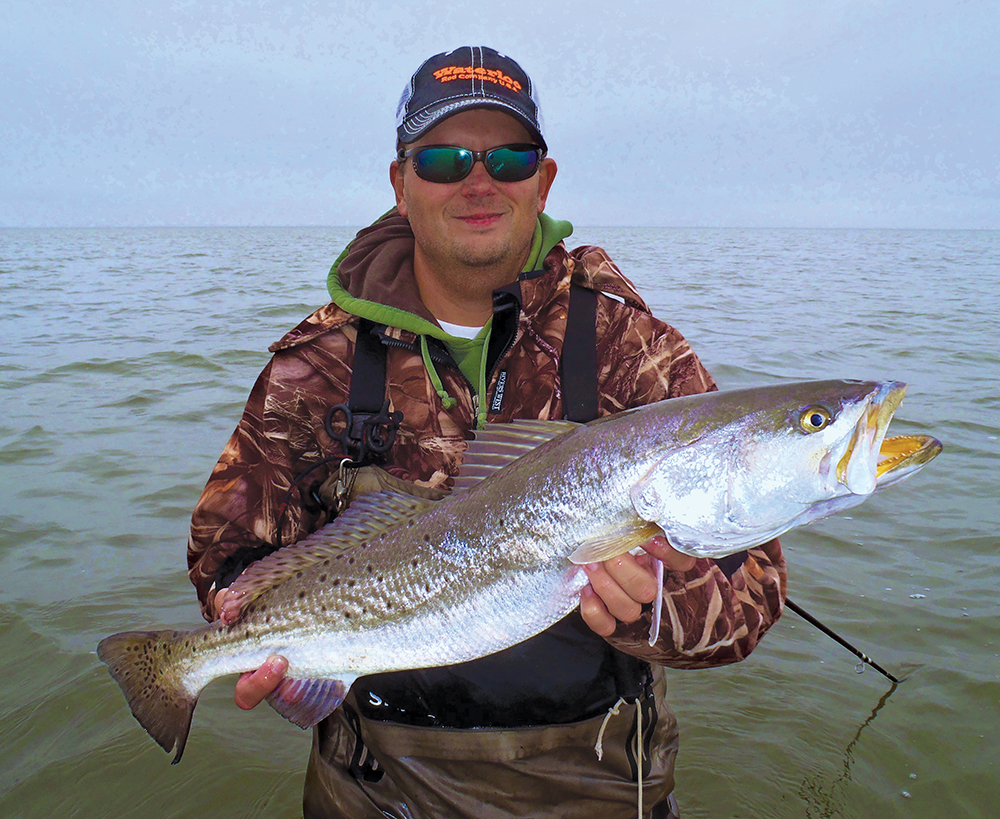
Over the course of the memorable day, we managed to catch about 15 long, fat trout, up to slightly more than 28 inches in length and weighing over 7 pounds. We lost at least 10 more after hooking them, while they jumped and thrashed and walked on their tails in the quiet calm. Significantly, we failed to hook at least a dozen more big specks which blasted off violently on our Spooks. While all this happened, another group of wading anglers worked the west end of Cathead, perhaps 200 yards to the south of us.
The benign conditions allowed us to clearly hear their conversations. They caught some big trout too, throwing soft plastics and slow-sinking twitchbaits. Following a well-known strategy, based on conventional wisdom, they chose to fish somewhat low and slow in the cold water, believing they wouldn't be able to catch trout on topwaters in those conditions. We know this because we heard them say so.
At some point, one of the members of the other group caught a trout weighing more than 9 pounds. While posing for pictures holding it, he told the cameraman, "I caught this one on a Catch 5. If the water warms up a little more, we might be able to get these fish to blow up on topwaters." Adrian and I laughed when he said this. We had not consciously whispered nor tried to conceal what we were doing from the others, and I have no idea how the sounds of the strikes we earned escaped their detection, but they apparently had no idea what was happening over in our corner of paradise.
Given what we wanted and what we earned, we found the whole thing amusing and satisfying. We felt smarter than the folks out on the rocky bar, because we knew something they could not know. Because they chose not to throw topwaters, they could not possibly know whether they would or would not work. Today, as I type, I apply meaning to those events in different ways than I did at the time they unfolded.
Adrian and I left the water that day with full hearts and knowing smiles on our faces. Truth be told, we placed more priority on catching the fish the way we wanted to catch them than on catching the biggest fish we could. In the end, we failed to catch the fish we went out there to catch. If we'd landed a trout measuring at least 30 inches or weighing at least 9 pounds, I could honestly say we did all the right things. We believe we did hook and lose some bigger trout than the ones we brought to hand, but we'll never know―a fish must be caught in order to be measured and weighed.
The guys on the rocks, on the other hand, did catch at least one trout meeting our standards, so in a sense, they did better than us, despite the fact they misread the situation in a significant way. In retrospect, these facts help me identify an important principle. Changing lures matters most when the bites come easy, not when they're almost impossible to earn.
I've typed it many times before and will here again―changing lures too often in a tough situation reveals ignorance about how the conditions in play dictate the use of specific kinds of lures. Throwing everything in the box at the fish during a slow bite isn't evidence of a maximal effort; it's proof of desperation. But choosing to change lures in intelligent ways when the catching is relatively easy can make perfect sense. The speed with which one can judge the relative efficacy of a new lure facilitates the utility of this truth. A new lure should produce bites from the right fish faster than the one it replaced, or it should be abandoned quickly.
If Adrian and I had tied on our Fat Boys and thrown them into the swirling, muddy boils left by the frantic mullet and the trout chasing them, we might have landed more and bigger trout. Similarly, if the dudes out on the rocks had thrown topwaters at their fish, they might have done the same. None of us will ever know, since we chose not to make changes and swing for the fences, likely because we all believed in the old, familiar adage―if it ain't broke, don't fix it.
The useful mantra applies to many aspects of life; some far removed from the water and the world of angling. But it's not an absolute. Sometimes, tweaking something that's working makes a good thing better. In the big trout game, experimenting thoughtfully with lure changes during a relatively hot bite can help anglers catch more and/or bigger fish.